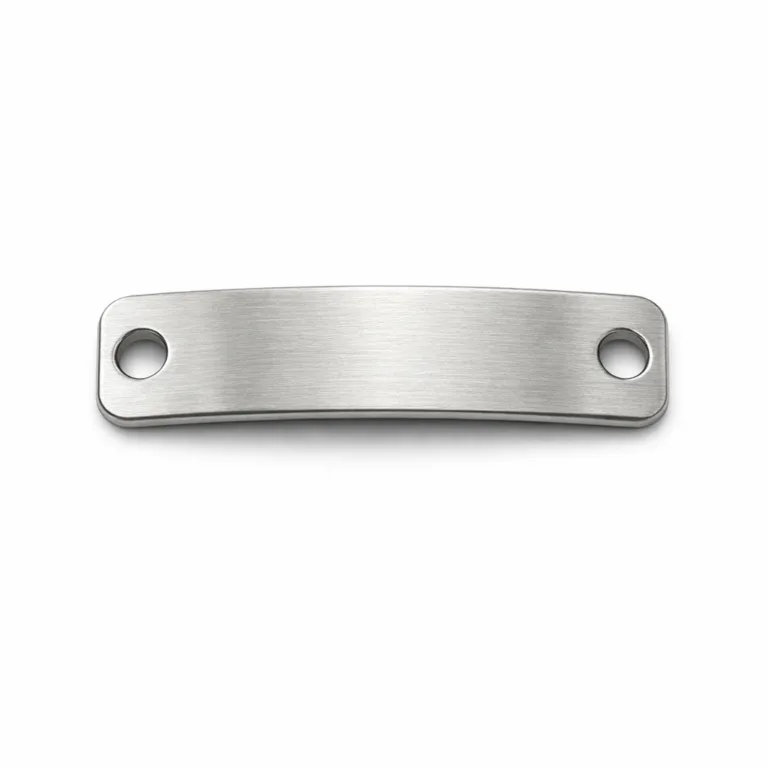
Introduction to ISO 9001 in Metal Manufacturing
Quality is at the heart of every successful metal manufacturing operation. The development of ISO standards in the past century transformed how industries worldwide set and meet quality benchmarks. Chief among these is ISO 9001, which emerged from the need to unify and clarify quality management guidelines across sectors—including the complex demands of the metal manufacturing industry.
ISO 9001, introduced in 1987 by the International Organization for Standardization (ISO), quickly became the globally accepted framework for establishing effective quality management systems (QMS). In the context of metal manufacturing—covering products like metal tags, nameplates, and industrial plates—ISO 9001 certification signals a manufacturer’s commitment to building reliable processes, reducing errors, and consistently meeting customer needs.
International customers, procurement officers, and engineers recognize ISO 9001 as proof that a manufacturer takes quality control seriously. This global recognition strengthens trust and opens up access to regulated industries where ISO compliance is mandatory.
ISO 9001 isn’t just a certificate to hang on the wall. It’s a cycle-driven approach that fosters continuous improvement, documenting systematic checks at every production stage. For metal manufacturers, this rigor is vital for ensuring tags are durable, readable, and consistent, batch after batch—a fundamental concern for every B2B buyer or engineer entrusting critical identification or branding components to a supplier.
By implementing ISO 9001, metal manufacturers not only safeguard end-product quality but also boost organizational efficiency, minimize costly recalls, and elevate customer satisfaction. Throughout this guide, you’ll see why ISO 9001 is essential to quality management in the metal manufacturing sector and how it delivers lasting value for buyers and suppliers alike.
Definitions and Basics of ISO 9001

ISO 9001 is the international standard outlining requirements for a quality management system. It is based on seven core principles: customer focus, leadership, engagement of people, process approach, improvement, evidence-based decision making, and relationship management. These concepts together ensure that metal manufacturing organizations can deliver products that meet both customer and regulatory requirements—repeatably and reliably.
Within the metal industry, these principles manifest in robust process controls, comprehensive documentation, and cross-departmental collaboration to meet tight product specifications. For example, a metal tag manufacturer may implement precise inspection procedures and error-proofing measures to ensure that every logo plate or asset tag leaving the facility is free from defects.
The scope of ISO 9001 in manufacturing reaches from raw material sampling through to final product shipment. It covers tasks such as supplier qualification, employee training, machine calibration, and packaging protocols—the entire journey of a metal component.
How does ISO 9001 differ from other standards? While ISO 9001 focuses on quality management across all processes, related standards, such as ISO 14001 (environmental management) or sector-specific guidelines (like IATF 16949 for automotive), layer additional requirements relevant to certain markets or applications. Yet, ISO 9001 remains foundational: many industry-specific certifications require it as a baseline.
In metal manufacturing, aligning with ISO 9001 sets the groundwork for producing components that stand up to rigorous use, whether in aerospace, electronics, or consumer goods. For buyers examining supplier claims, knowing their partners are ISO 9001 certified is a powerful first filter for quality assurance.
Significance of ISO 9001 in Quality Management
Implementing ISO 9001 transforms quality management into a predictable, measurable process. In metal manufacturing, this has a direct impact on product consistency and reliability. Buyers seeking industrial-grade tags or plates rely on the confidence that each batch will adhere to precise tolerances.
ISO 9001-compliant companies establish standardized work instructions and regular audits—resulting in lower defect rates. For example, consider an operation where poorly stamped serial number tags once led to a 5% rejection rate. By adopting documented ISO processes, defects fell to less than 1%, slashing rework costs and assembly line delays.
This improvement doesn’t just save money—it directly influences customer satisfaction. Engineers and procurement specialists can depend on consistent quality, streamlining their own workflows. Reduced defects also mean fewer customer returns and warranty claims.
The relationship between quality management and operational efficiency is especially pronounced in metals. Standardized procedures minimize the risk of variability in finishing, hole alignment, or engraving depth. This enables manufacturers to meet tight lead times without sacrificing precision—a non-negotiable requirement for industries like aerospace and medical devices.
A real-world example: One European metal tag manufacturer, struggling with inconsistent anodized finishes, overhauled its quality management based on ISO 9001. By integrating in-line inspections and corrective action logs, the company increased its on-time delivery of conforming tags to 99.7%. This not only built customer loyalty but enabled expansion into regulated markets.
At UC Tag, production veteran Rain Chen often reminds new staff that “documenting small process tweaks—like laser focus checks or routine fixture cleaning—prevents major headaches down the line.” This daily discipline reflects the true value of ISO 9001-driven quality management: empowering teams to identify, prevent, and solve problems before they reach the customer.
Materials Comparison in Metal Tag Production
The selection of materials is foundational to both product performance and compliance with quality management standards.
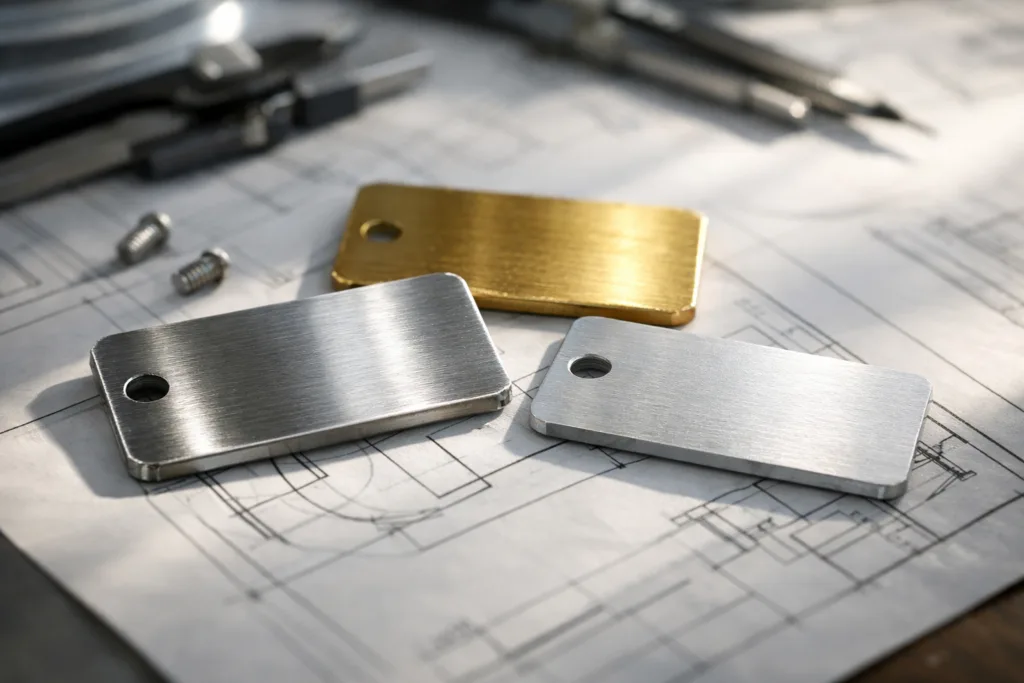
- Aluminum: Lightweight, naturally corrosion-resistant, and ideal for anodized color finishes. It is widely used for durable, readable asset tags—indoors and outdoors—but can be less impact-resistant than steel.
- Stainless Steel: Offers maximum strength, temperature resilience, and long-term corrosion resistance—even in harsh chemical environments. Preferred for heavy-duty applications, but higher cost and machining complexity come with the territory.
- Brass: Known for its warm gold-like appearance and ease of engraving or stamping. Prominent in branding applications and traditional luggage tags. However, it may tarnish over time and is softer than steel.
How do these choices impact ISO compliance? Surface integrity, corrosion resistance, and UV durability are all key to meeting documented tag specifications. For instance, ISO 9001 documentation may require evidence that selected materials align with intended environment and application.
Here’s a comparative table for quick reference:
| Material | Strengths | Weaknesses | ISO Compliance Notes |
|---|---|---|---|
| Aluminum | Corrosion-resistant, lightweight, colorable via anodizing | Softer, scratches easier, lower tensile strength | Ideal for color coding and lightweight tags; requires precise surface prep for engravings |
| Stainless Steel | Maximum durability, chemical/heat resistance, no rust | Harder to machine, heavier, costlier | Best for harsh conditions; critical in safety/compliance-driven sites |
| Brass | Classic look, easy to engrave/stamp, good machinability | Tarnishes, softer, can react with some chemicals | Popular for premium branding; must meet ISO finish specs for uniformity/readability |
For further guidance on picking materials by application, see our post on Stainless Steel vs Aluminum Dog Tags.
Manufacturing Methods Comparison for Quality Assurance
The method selected for producing metal tags greatly affects their compliance with quality management standards. Each process brings distinct trade-offs in cost, precision, and durability:
- Engraving (Laser or CNC): Provides sharp, permanent detail. Excellent accuracy for serial numbers and barcodes; low risk of fading. Laser engraving is especially useful for detailed logos and small fonts.
- Stamping: Delivers deep, tactile letterforms and logos. Extremely durable, especially for high-traffic asset tags. However, stamping can introduce stress to thinner materials and is usually best for simpler designs.
- Chemical Etching: Enables intricate graphics and fine lines. Offers consistent depth across batches, but may require secondary processes for coloration or contrast.
- Printing (UV or Sublimation): Allows photographic images and complex colors. Typically less permanent, but high readability in short-term or indoor applications.
ISO 9001-driven operations standardize the selection of methods by project brief, production volume, and end-use environment. For example, asset tags destined for refinery sites may specify deep engraving on stainless steel, while retail product branding could leverage color-printed anodized aluminum for visual flair.
Manufacturing methods also determine how well tags resist abrasion or UV fading—a critical quality issue. At UC Tag, Rain Chen cites an example: “An outdoor labeling job with laser-etched anodized aluminum failed because the customer underestimated exposure—after a year, UV tests revealed fading. Now, specs require UV-printed overlays or opting for etched stainless when permanent readability is required.”
This kind of up-front, methodical selection—aligned with quality management expectations—prevents failures, reduces warranty costs, and keeps customer satisfaction high.
Design and Spec Checklist for Quality Compliance
Quality management in metal tag production starts long before the factory floor—it hinges on documenting specifications that are achievable and suitable for the application.
- Size and Thickness: Clearly specify in millimeters or inches for cut and finish accuracy. Confirm the substrate can accommodate desired engraving or stamping depth.
- Finish Type: Indicate if you require brushed, polished, anodized, or plated surfaces; finish may impact readability.
- Attachment Requirements: Note holes, slots, notches, adhesives, or rivet options to ensure reliability in final installation.
- Readability: Select clear, high-contrast fonts and appropriate sizing—legibility is a core element of ISO 9001 compliance. For tips, refer to our readability and durability design guide.
- Tolerances: Set realistic tolerances for hole diameters, edge finishing, and overall dimensions. ISO QMS will require these values to be documented and checked during production.
- Environmental Considerations: Note if tags must withstand chemicals, sunlight, abrasion, or temperature extremes; this often informs material and finish choices.
- Review & Approval: Always request pre-production proofs or samples for approval before mass production.
Check out our guide to avoiding design mistakes that delay orders for more best practices when specifying metal tags.
Durability Testing and Quality Assurance
No tag is truly “quality managed” without in-depth durability testing. ISO 9001 references specific approaches to verifying product robustness—especially important for metal tags in harsh industrial or outdoor environments.
Typical tests include:
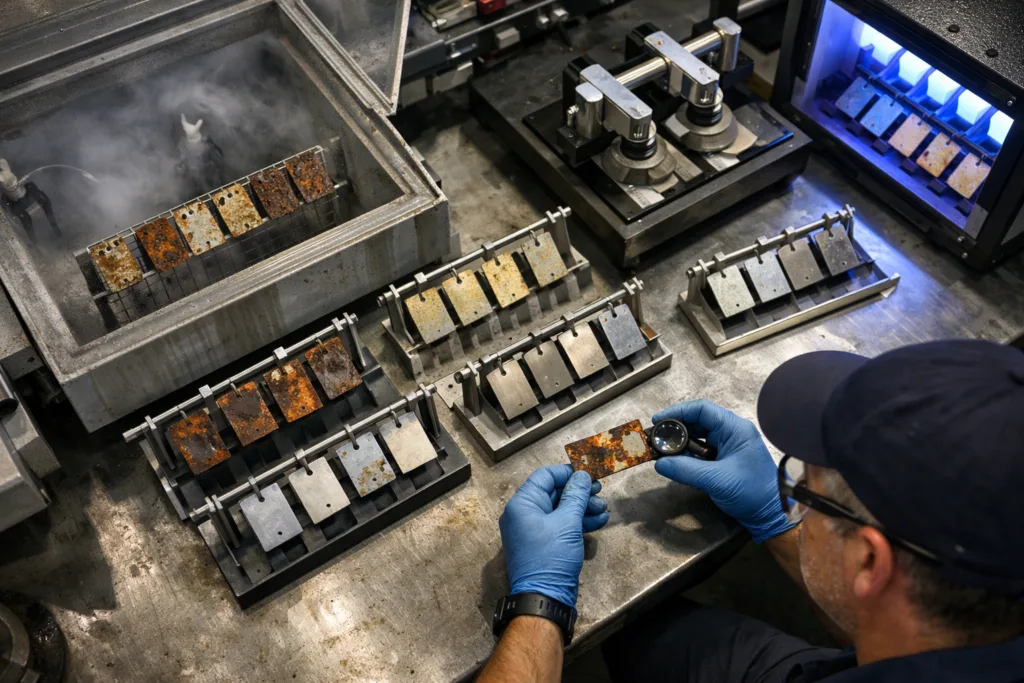
- Corrosion Testing: Exposure to salt spray or humidity chambers to replicate years of outdoor use.
- Abrasion Resistance: Gauging endurance against scratches or rubbing from frequent contact.
- UV Exposure: Simulating high sunlight levels to monitor fading or loss of readability.
These results must be compared to documented requirements in the QC plan—ISO 9001 establishes the framework for both pass/fail criteria and the methods to capture and respond to test data. Omitting these steps risks early failures, which can lead to costly replacements and lost customer trust.
Consider a real-world scenario: A batch of logo plates for a shipping line passed initial inspection but failed within six months due to inadequate salt spray testing. The tags showed corrosion spots, prompting a recall. With ISO 9001 processes in place, manufacturers detect such risks earlier through routine production sampling and scheduled test intervals.
Material selection directly enhances durability. For high salt environments, stainless steel may be mandated, while aluminum tags with hard anodizing may suffice for urban installations. Frequencies of durability checks should be set based on production volume and criticality—monthly for high-turnover SKUs, or every batch for safety-critical tags.
Proper durability validation is not a box-ticking exercise; it is an integral, ongoing aspect of quality management that ensures your tags perform for years in their intended environment.
Application Fit: Industries and Use Cases
ISO standards are foundational to a wide spectrum of industries requiring metal tags—from aerospace to electronics and logistics. In each case, quality management ensures traceability, safety, and brand reputation.
Aerospace relies on ultra-durable, tightly specified tags for aircraft components. Automotive manufacturers use serialized tags to track parts from factory to vehicle assembly—defect-free tags are mission critical for recalls. Electronics and data centers demand clear asset or cable markers, often validated through environmental and electrical safety standards.
- In food and beverage packaging, tags may need extra compliance with food-grade materials and readable barcodes, as described in our food-grade safety guide.
- For military and emergency equipment, ISO 9001 certification can be a prerequisite for supplier selection, as high reliability is non-negotiable—see our government specs guide.
- Consumer luggage and branding applications balance durability with aesthetics, often involving unique finish requirements or custom die-cut shapes.
One luxury goods manufacturer recently implemented a new tag system for its premium handbags, requiring serialized logo plates manufactured under ISO-driven quality controls. As a result, the company reduced counterfeiting risk and improved authenticity tracking for global distribution—highlighting the commercial value of integrated quality management.
Wherever traceable identity, branding, or compliance is vital, ISO 9001 is a baseline for vendor selection. Documented QMS processes support not only industry audits, but also risk management across entire supply chains—giving procurement teams the confidence to partner with trusted suppliers.
Common Mistakes and Troubleshooting in Tag Manufacturing
Even with robust systems, errors can slip into metal tag production. The most frequent issues that undermine quality management goals include:
- Poorly readable text—often due to undersized fonts, low contrast, or inappropriate engrave depths.
- Wrong adhesive or attachment choice, causing tags to detach in the field.
- Material mismatches—using substrates prone to corrosion in wet or chemical-exposed environments.
Troubleshooting starts by retracing the original specification against observed failures. For unreadable text, review design proofs and consider increasing size or stroke width; consult our durability and selection guide for more on choosing between engraving and printing.
Insufficient quality checks are a major root cause—ISO 9001’s emphasis on regular process audits and sample reviews can catch trends before they become widespread. For adhesive issues, request environmental compatibility testing before rollout.
Continuous improvement is at the heart of ISO-based quality management. Collect feedback, analyze failure patterns, and adjust specifications proactively to prevent recurring headaches. Training and routine cross-checks are essential levers for raising manufacturing reliability over time.
Ordering Guide for Metal Tags: Achieving Quality Compliance
The process of ordering high-quality, ISO-compliant metal tags hinges on clarity and proactive communication throughout the supply chain.
- Minimum Order Quantities (MOQ) & Lead Times: Clarify upfront, as short runs or highly customized tags often require additional setup time or costs. Refer to our guide to MOQs for practical tips.
- Accurate Artwork and Proofing: Submit vector files where possible and approve digital proofs. ISO 9001 workflows document these steps for traceability—reducing risk of mix-ups.
- Packaging and Shipping: Choose packaging that protects finish and prevents damage in transit. Discuss bulk vs. retail packaging and note any special shipping needs (e.g., international compliance); more advice can be found in our shipping and customs guide.
- Sampling: Always request a pre-production sample, especially for first orders or updated designs. This allows in-person verification of specs and finish—and gives one more ISO-aligned check before mass production.
- ISO Compliance: Ask the manufacturer to provide their ISO 9001 certificate and explain their QMS process. Experienced partners will outline how your order is checked, tracked, and documented to ensure repeatable quality.
Aligning every step, from RFQ to shipment, with ISO 9001 practices is your safeguard for consistent quality and regulatory compliance, regardless of volume or complexity.
Frequently Asked Questions
What is ISO 9001 and its significance in metal manufacturing?
ISO 9001 is an international standard for quality management systems that ensures consistent processes and control in metal manufacturing, leading to reliable, compliant products and increased buyer confidence.
How can my company achieve ISO 9001 certification?
Start by implementing documented quality management processes, train staff, perform internal audits, and then engage a recognized certification body to complete a third-party audit for ISO 9001 certification.
What are the costs associated with ISO certification?
Costs include consultant fees for system setup, staff training, documentation, internal audits, and the certification audit itself, with amounts varying widely by company size and scope of operations.
How often do ISO certifications need to be renewed?
ISO 9001 certifications must be renewed every three years, with surveillance audits typically required annually to maintain certified status and ensure ongoing compliance with standards.
What documentation is required for compliance?
Key documentation includes quality manuals, standard operating procedures, process records, test logs, corrective action reports, and evidence of management review and continuous improvement.
How does ISO 9001 impact customer relationships?
ISO 9001 improves customer relationships by ensuring reliability, traceability, and consistent quality, enabling greater trust, smoother audits, and fewer disputes over product performance and compliance.
Related Reading
- Stainless Steel vs. Aluminum Tags: Make the Right Material Choice for Your Needs
- Engraved vs. Printed Metal Tags: How to Ensure Durability and Readability
- The Truth About MOQs: What Buyers Need to Know Before Ordering Custom Metal Tags
- Food-Grade Metal Tags: Safety Standards Every Producer Should Understand
- Military Tag Specifications: How to Comply with Official Government Standards