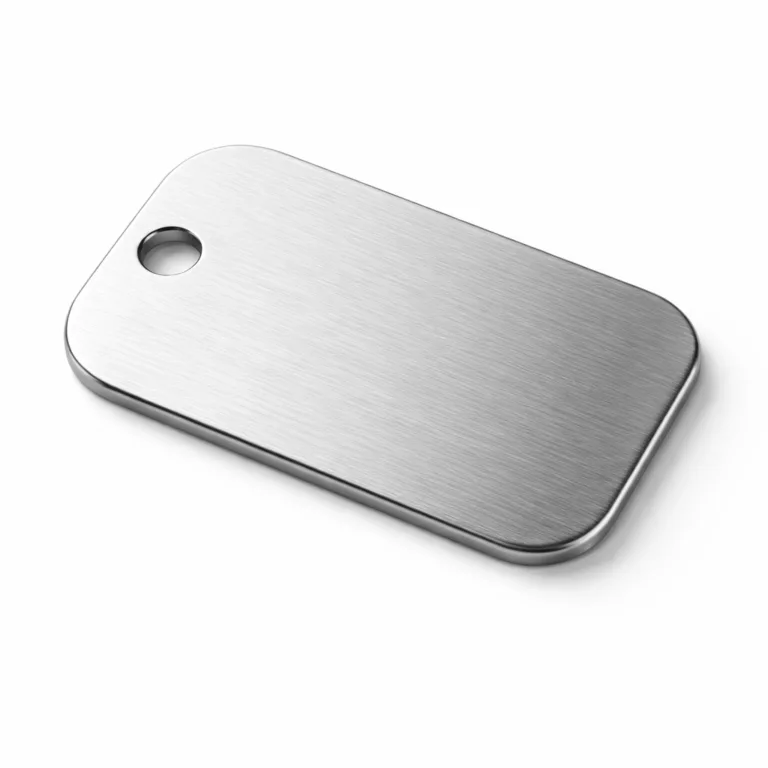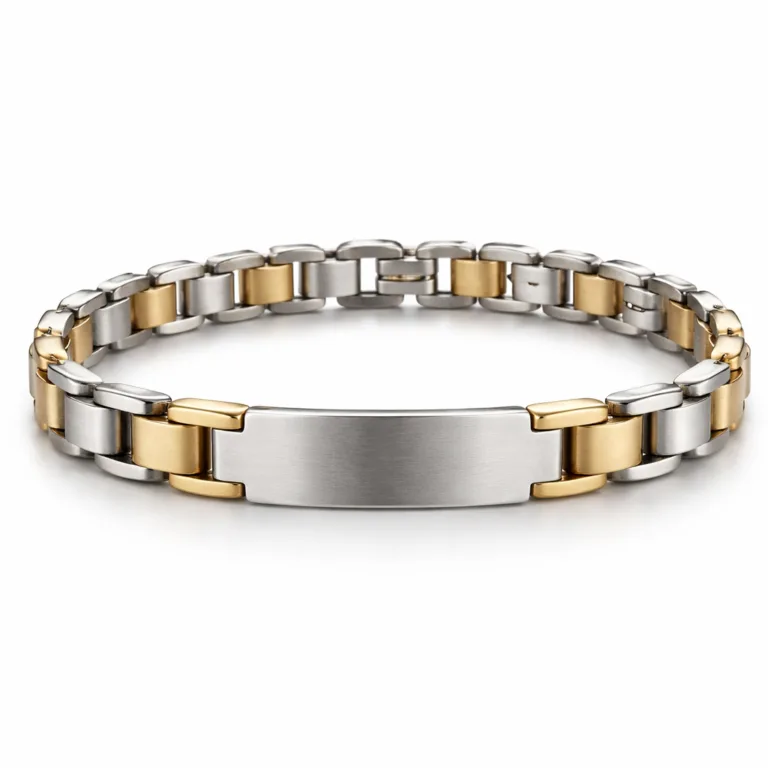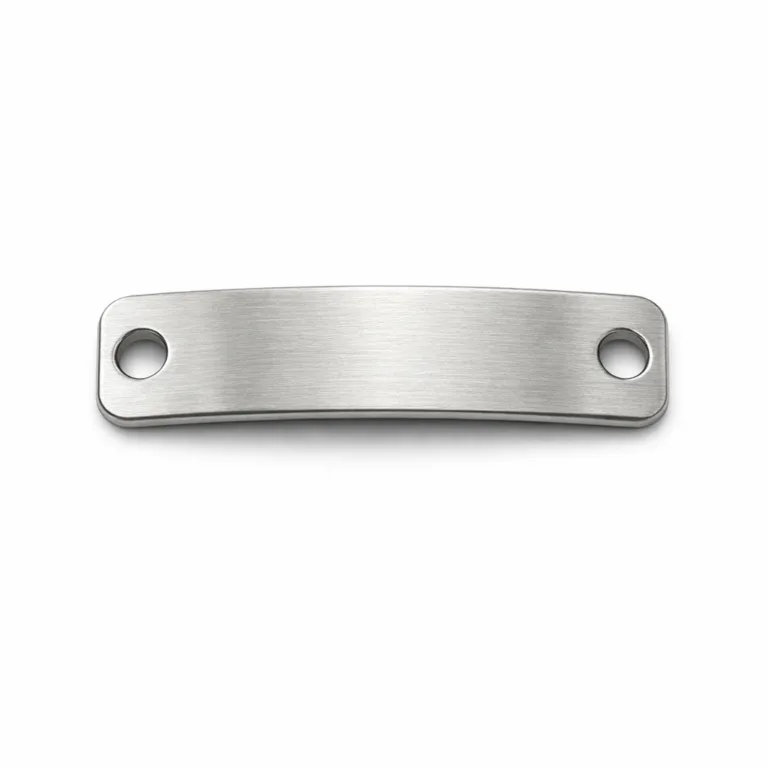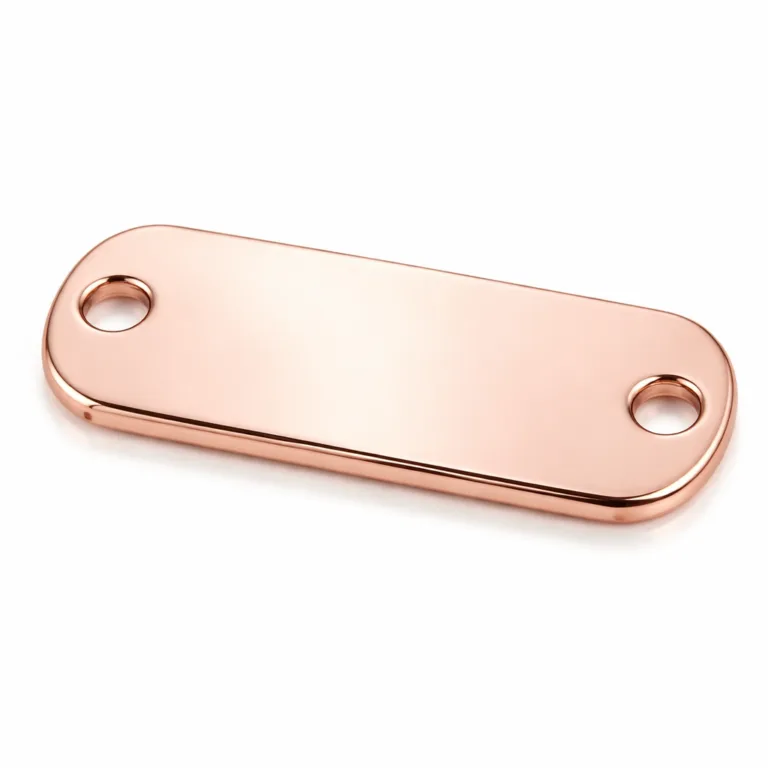
In a server room, cable management is not just about neat bundles and tidy racks. It is about making every cable easy to trace, service, and replace without causing avoidable downtime. When a cabinet is dense, changes happen often, and technicians are working under time pressure, the label has to do real work. That is where metal tags become useful: they stay readable, hold up to handling, and support a more disciplined identification system for power, network, and control cables.
If your project needs custom dimensions, numbering, attachment choices, or a cable identification scheme that can scale across racks, our custom metal tag manufacturing solutions page shows how we plan material selection, marking method, hole placement, and sample approval before production starts. From a manufacturer’s point of view, the right tag is not only a label; it is part of the maintenance process, especially when the buyer wants consistent identification across many cabinet rows or future expansion phases.
What Cable Management Means in Server Rooms
Good cable management in a server room means more than bundling cords into neat paths. It means every cable has a known purpose, a clear origin and destination, and an identification method that still works after repeated servicing. When a technician needs to replace a switch, trace a patch lead, or isolate a fault, cable identification should reduce guesswork instead of adding another step.
In practice, poor cable management creates small problems that turn into bigger ones. A cable can be routed through the wrong path. A service call can take longer because a label is hard to read. A rack expansion can introduce confusion when older and newer cable sets use different naming styles. Metal tags help because they support a more permanent system that stays visible when the environment is busy, warm, and frequently touched.
For server rooms and data centers, the label strategy should fit the work pattern. If cables are rarely moved, a simple identification system may be enough. If the room is updated often, the label needs to withstand repositioning, cleaning, and recurring inspection. That is why buyers often move from temporary stickers to a more durable cable tag design.
Why Metal Tags Are a Strong Choice for Server Room Cable Identification
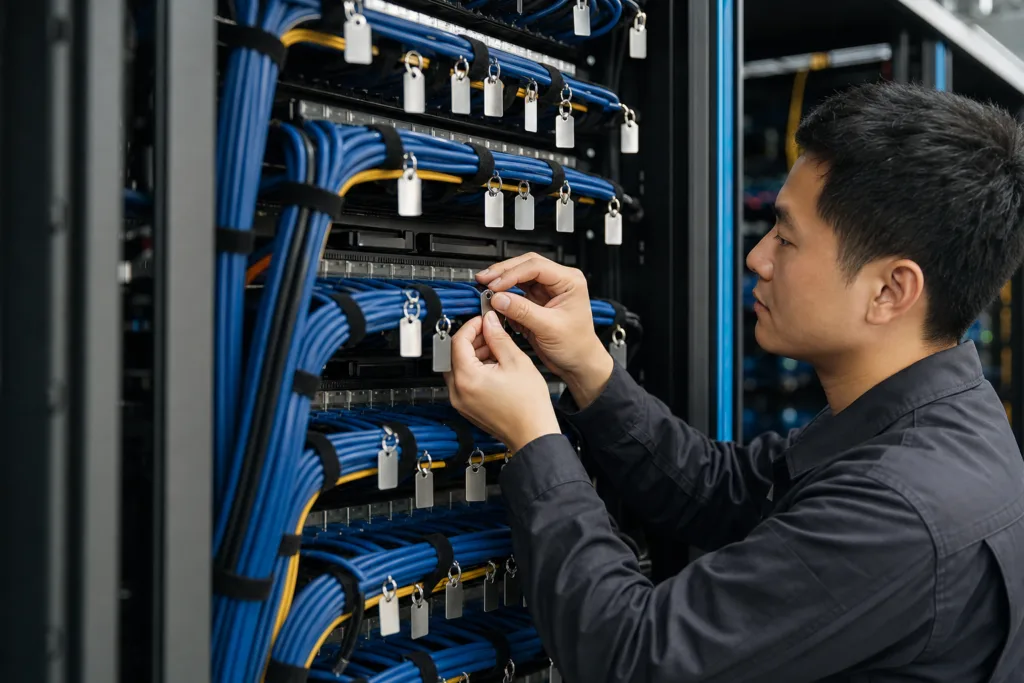
Metal tags are a strong choice because they balance durability, legibility, and long-term consistency. A cable room may not face outdoor weather, but it does face heat from equipment, dust buildup, tight bends, repeated hand contact, and the risk of labels peeling or fading. A tag made from aluminum or stainless steel handles those conditions better than many short-life label materials.
We usually recommend buyers look at the whole use case before choosing the tag material or marking method. The same rack row can contain power feeds, data cables, grounding leads, and temporary service lines. If each type of cable is tagged differently, technicians waste time learning the system. If the tags follow one pattern, maintenance becomes simpler and safer. Our industrial metal tag selection guide is useful here because it shows how material, surface finish, and marking method should be matched to the application instead of chosen by appearance alone.
Metal tags also help when the identification needs to last for years. In a server room, a label that looks fine on day one may become hard to read after a few service cycles. Metal keeps the base structure stable, and the mark can be made by engraving, etching, stamping, or durable printing depending on the project. For buyers planning long service life, that stability is often the real value.
Common Cable Management Problems Metal Tags Help Solve
Most cable management issues in server rooms are not dramatic on their own. The problem is that they compound over time. One unclear label turns into one wrong trace, then one delayed repair, then one risky change made under pressure. Metal tags help reduce those failure points.
- Clutter: dense bundles are easier to sort when each cable carries a durable identifier instead of a fading sticker.
- Misrouting: consistent tags make it easier to follow a cable from port to endpoint and reduce the chance of connecting the wrong line.
- Downtime: faster identification shortens troubleshooting and makes scheduled maintenance easier to complete on time.
- Maintenance errors: technicians are less likely to disturb the wrong circuit when the cable is clearly marked.
- Change confusion: during expansions or swaps, older cables and new cables can be kept under the same numbering logic.
These are not abstract benefits. They show up during actual work: a failed switch replacement, a rack migration, a cable audit, or a late-night service call. In those moments, the tag either helps or gets in the way.
Types of Metal Tags for Cable Management
Different cable environments call for different tag structures. Some projects need a simple engraved plate. Others need a small tag with a hole or adhesive back. The key is to match the tag style to the way the cable is routed and how often it will be touched.
| Tag Type | Best Use | Strength | Watch-Out |
|---|---|---|---|
| Engraved metal tags | General cable identification | Clear, durable marking | Needs enough surface space for readable text |
| Stamped metal tags | Simple IDs and fixed codes | Strong mark depth | Less flexible for fine graphics |
| Etched metal tags | Compact text and codes | Good detail on a stable substrate | Contrast must be planned carefully |
| Anodized aluminum tags | Lightweight cable and rack labeling | Good readability with color contrast | Surface and marking method must be matched well |
| Stainless steel tags | Heavy-use or high-moisture areas | Excellent durability and corrosion resistance | Usually a higher-cost option |
| Adhesive-backed metal tags | Smooth surfaces or fast installation | Simple attachment | Surface prep matters a lot |
For buyers comparing these options, the real question is not which type sounds strongest. It is which type will remain readable and securely attached in your server room after repeated servicing. A tag that looks robust but is hard to inspect is not a good choice.
How to Choose the Right Material for Server Room Conditions
Material selection is where many cable tag projects succeed or fail. If the room is dry, lightly serviced, and temperature stable, anodized aluminum may be enough. If the room has higher humidity, frequent touch points, or a stronger requirement for long service life, stainless steel can be a better fit. Stainless steel is widely used because its chromium-based passive film supports corrosion resistance in demanding conditions, which is why buyers often compare it carefully before committing to a tag program; for background on that material behavior, see SSINA’s stainless steel resources.
Heat also matters. Server rooms may not reach extreme industrial temperatures, but heat from equipment, airflow, and power distribution still affects label performance over time. If a cable tag is near warm equipment or a high-touch path, the marking method should stay stable. Our high-heat durability guidance for metal tags is helpful for buyers who want to understand how substrate choice, marking depth, and finish affect long-term readability under heat stress.
As a manufacturer, we usually ask three practical questions before recommending a material: how often will the cable be moved, what is the expected lifespan, and what is the worst condition the tag will face? Those answers are often more useful than simply asking for the cheapest option.
Material Comparison Snapshot
- Aluminum: lighter weight, often more cost-efficient, and useful when the project needs good readability without excess mass.
- Stainless steel: better for harsh handling, longer life, and environments where corrosion resistance matters more than initial price.
- Finished surfaces: anodized or coated surfaces can improve contrast, but the marking method must be compatible with the finish.
Tag Design Considerations That Affect Real-World Use
Size, shape, hole placement, finish, and text layout all affect whether a tag works on the cable or gets ignored. In server rooms, the tag should be readable without requiring the technician to untie a bundle or rotate a cable into an awkward position. Small decisions here can create big problems later.
Size and shape: the tag should fit the available space while keeping the text large enough to read quickly. A tag that is too small may force cramped text, which is a problem when a room uses long equipment IDs or location codes.
Hole placement: if the tag is tied, riveted, or wired on, the hole must support stable hanging without blocking the text. In cable work, we often see tags placed too close to the edge, which increases wear and makes the tag swing in a way that hides the message.
Finish and contrast: a brushed, anodized, etched, or printed finish can improve readability, but only if the mark remains clear under the room’s lighting. Reflective glare can be a problem in bright equipment spaces, so the finish should be planned with the actual viewing angle in mind.
Text layout: a clean line structure is easier to scan than a crowded block of data. If the tag needs a serial number, rack reference, and circuit note, the hierarchy should be clear. The most important information should be the easiest to read.
Labeling Methods for Cables in a Server Room
Cable labels should support the way technicians work. For many facilities, that means a consistent code that ties the cable to a rack, port, endpoint, or circuit path. A good labeling method does not need to be complicated, but it does need to be repeatable.
Structured cabling administration works best when identifiers are consistent across the whole site. That is why professional cabling documentation often uses permanent identification, repeated at accessible points, so technicians can trace a line quickly during service or audit work. The structured cabling identification practices in BICSI’s telecommunications distribution manual support that approach and match what many server room teams need in practice: clear, repeatable, and durable identification that survives future maintenance.
In our production work, buyers often use one of these systems:
- Serial numbers: useful when each cable needs a unique ID for traceability.
- Equipment IDs: simple when the cable is tied to a known asset, rack, or device.
- Location codes: helpful for multi-row rooms where the path matters as much as the endpoint.
- Barcodes or QR codes: best when the cable data must link to a digital record or maintenance system.
- System references: useful when the label needs to show power, network, or circuit group information.
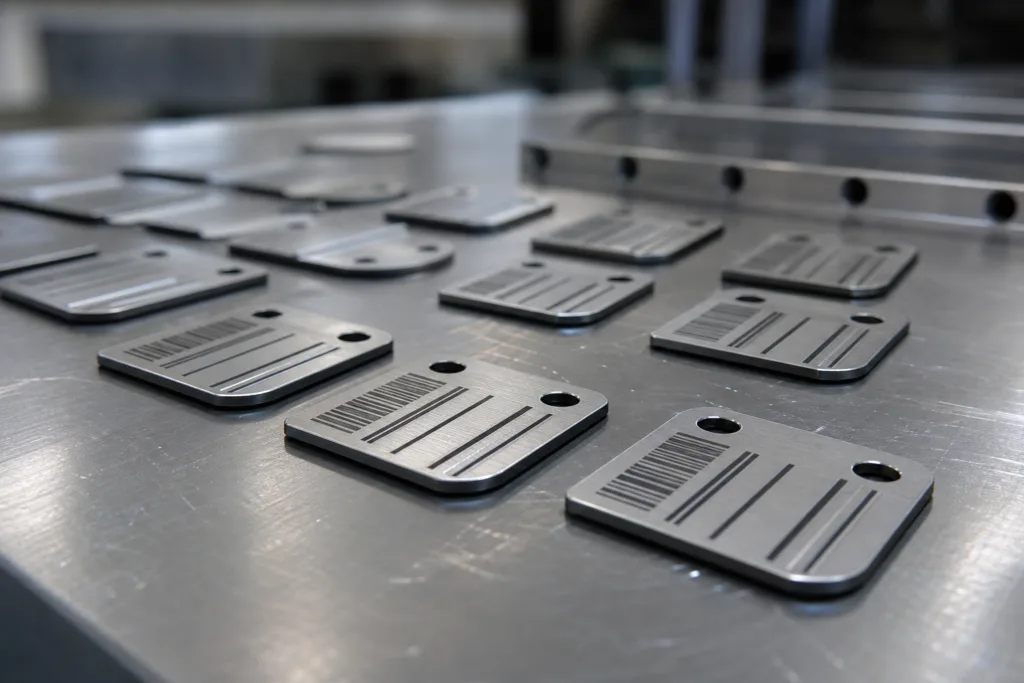
For data-heavy sites, the label often needs both human-readable text and a machine-readable code. That is where careful artwork setup matters. Our barcoded plates for equipment tracking article covers the same production logic that applies to cable tags: code size, contrast, quiet space around the code, and file accuracy all affect scan performance.
Readability and Durability in High-Use Environments
A server room is not a decorative environment. Labels are touched, bent around bundles, wiped during cleaning, and inspected under time pressure. A good tag must remain legible after that repeated use. For that reason, we pay close attention to engraving depth, surface contrast, edge finishing, and how the tag will sit on the cable once installed.
Readability is not only about font choice. It is also about the relationship between text size, contrast, and viewing distance. If the technician can only read the tag by pulling a cable bundle apart, the label is not doing its job. The best cable identification systems are simple enough to read quickly and strong enough to survive routine work.
If the project includes engraved marks, the mark depth and edge quality matter. Shallow marks may look fine at first but lose clarity faster under cleaning and abrasion. Deep marks are not always necessary, but the choice should match the environment and expected service cycle. When the room has repeated touchpoints or a long maintenance horizon, the safer approach is to favor higher visibility and a more stable base material.
Best Practices for Labeling and Installing Cable Tags
Even a well-made tag can underperform if the installation method is poor. In server rooms, the best results usually come from standardizing both the tag format and the installation point. That way, technicians do not have to guess where to look or how to interpret the label.
We recommend a few simple rules:
- Place the tag where it can be read without moving the cable too far from its normal position.
- Avoid placing the tag directly against a connector, bend radius, or sharp edge.
- Keep the same orientation across all racks so technicians know where to look.
- Use the same naming logic for every cabinet row and expansion phase.
- Confirm that the tag does not interfere with airflow, latches, or service access.
At UC Tag, we usually treat these installation details as part of the product design, not as an afterthought. If a buyer wants hole punching, wire attachment, chain attachment, screw mounting, or adhesive backing, we plan the structure around how the cable will actually be used. That is especially important for private label projects and OEM programs where the same standard must work across multiple sites or customer accounts.
Artwork and Data Preparation for Bulk Cable Tag Orders
Bulk cable tag orders are often delayed by small data issues, not by production capacity. The most common problem is a file that looks clear to the buyer but is not clean enough for manufacturing. A missing digit, an inconsistent code pattern, or a poorly formatted spreadsheet can create errors across an entire batch.
For cable management projects, we usually ask for a list that shows the exact text, code sequence, quantity, and any location reference. If there are barcode or QR code requirements, the data should be checked before final approval. The same is true for variable numbering: once a numbering series starts, it should be locked before production begins.
Good artwork preparation also includes confirming:
- tag size and text area
- font style and minimum readable size
- hole position or attachment method
- single-sided or dual-sided marking
- data sequence and sample approval
This is where a manufacturer can save time for the buyer. The cleaner the data handoff, the less likely the job will need correction later.
Quality Control Factors That Matter for Reliable Cable Tags
Quality control for cable tags is not only a final inspection step. It starts with material verification and continues through marking, finishing, and packaging. If the tags are going into a server room, a small defect can create a maintenance problem later.
The main QC points we review are engraving depth, print or etch clarity, alignment, edge finishing, attachment strength, and readability under normal viewing conditions. For barcodes or QR codes, the code should be checked for scanning consistency, not just visual appearance. For numbered tags, sequence accuracy matters as much as the finish.
Packaging also matters more than many buyers expect. If tags arrive scratched, bent, or mixed into the wrong sequence, the install team loses time before the first cable is even labeled. For OEM and private label programs, clean packaging and count verification are part of the job, not extra decoration.
Practical Examples From Server Room Work
Troubleshooting example: a technician needs to locate a fault in a dense rack after hours. With durable metal tags on the cable ends and a consistent numbering system, the technician can trace the line quickly instead of checking every bundle. That shortens service time and reduces the chance of disturbing neighboring circuits.
Expansion example: a server room adds a new rack row and several patch runs. If the original cables use one naming pattern and the new cables use another, the site becomes harder to manage over time. Standardized metal tags help the installer keep the same logic across the new work, so future maintenance remains simple.
These examples may sound basic, but they reflect how most cable management issues are actually solved: by making the next technician’s job easier.
Cost Drivers and Sourcing Considerations
Custom metal cable tags are not priced by material alone. Cost is shaped by the substrate, marking process, size, quantity, attachment style, numbering complexity, packaging, and sample requirements. A buyer comparing quotes should look at what is included, not only the unit price.
Common cost drivers include:
- stainless steel versus aluminum substrate
- engraving, etching, stamping, or printing method
- number of data fields and variable serials
- attachment hardware or adhesive backing
- special finish, color contrast, or anodizing
- sample runs, packaging, and private label needs
For teams budgeting a new cable identification program, it helps to separate the initial product cost from the long-term cost of confusion, rework, and maintenance delay. A lower-price tag that fails early is rarely the better choice.
Common Mistakes to Avoid
One common mistake is choosing a label style before confirming the installation environment. Another is using a label size that looks fine on paper but becomes too small once the actual text is added. A third is not standardizing the naming scheme before sample approval, which often leads to rework during bulk production.
Buyers also sometimes overlook attachment details. A cable tag can be made correctly but still fail if the hole position, tie method, or adhesive choice does not match the cable surface. In server rooms, that kind of mismatch creates avoidable maintenance issues later.
The simplest way to avoid trouble is to think like the future technician. If the person opening the rack six months from now cannot identify the cable quickly, the project needs a better labeling plan.
Checklist for Choosing a Metal Tag Manufacturer
- Can the supplier support the required material, marking method, and attachment style?
- Will they help review artwork, numbering, and barcode data before production?
- Do they provide samples so the buyer can confirm readability and fit?
- Can they keep the same identification logic across repeat orders and expansions?
- Do they check edge finish, attachment strength, and packaging consistency?
- Can they support OEM, ODM, or private label requirements if the project grows?
When those answers are clear, the sourcing process becomes much easier. The best cable tag supplier is not just the one that can make the part; it is the one that can make the part fit the work environment.
Conclusion

Metal tags support cable management in server rooms because they make identification more durable, more consistent, and easier to maintain over time. They help technicians trace cables faster, reduce mistakes during service, and keep expanding rooms under control as the installation grows. For buyers, the real decision is not whether to label cables, but how to label them in a way that still works under repeated use.
When the material, marking method, size, and attachment style are matched to the actual server room conditions, the result is a cleaner and safer maintenance workflow. That is the practical value of choosing metal tags for cable management: fewer surprises, faster service, and better long-term order.
FAQs
Why use metal tags instead of plastic labels for server room cables?
Metal tags hold up better when cables are touched, rerouted, cleaned, or exposed to heat. They stay legible longer and reduce the chance that a label peels off during maintenance.
Which metal is better for server room cable tags, aluminum or stainless steel?
Aluminum is often a good fit when the project needs lighter tags and balanced cost. Stainless steel is usually better when the environment needs stronger corrosion resistance, more frequent handling, or a longer service life.
Should cable tags be engraved, etched, or printed?
Engraved and etched marks are often preferred when readability and durability matter most. Printing can work well too, especially when the project needs color or extra data, but the best choice depends on wear, heat, and how often the tag will be handled.
Where should cable tags be attached on a server room cable?
The tag should be placed where it can be read without moving the cable too far from its normal position. Avoid placing it directly against connectors, tight bends, or sharp edges, and keep the same orientation across the room.
Can metal tags carry barcodes or QR codes clearly?
Yes, if the data file, code size, contrast, and layout are prepared correctly. The barcode or QR code should be tested before bulk production so the scanning result matches the maintenance system.
What should I confirm before placing a custom cable tag order?
Confirm the material, size, attachment method, numbering system, barcode or QR code data, sample approval process, MOQ, lead time, and packaging. That keeps the order aligned with the server room’s real installation and maintenance needs.