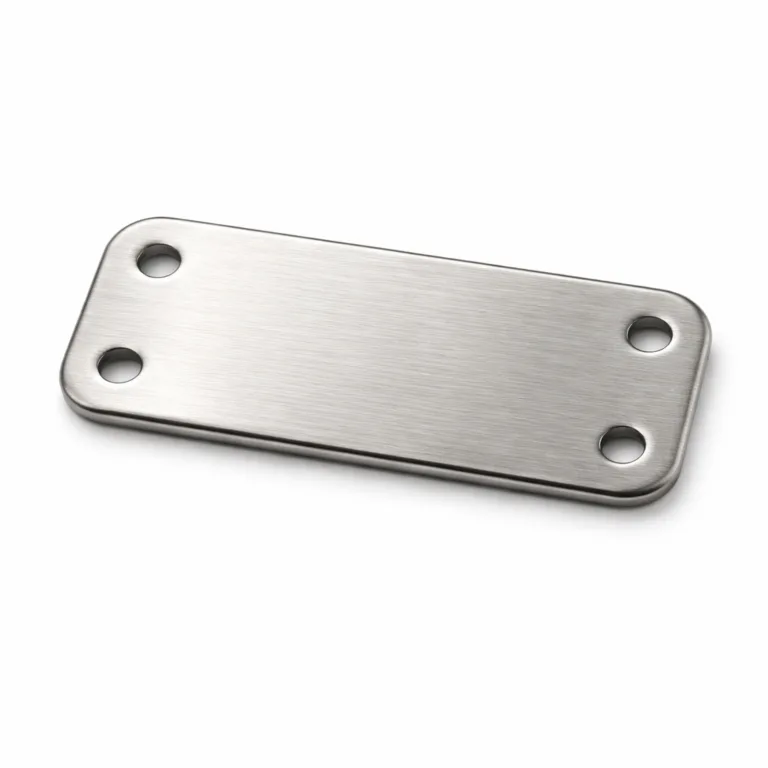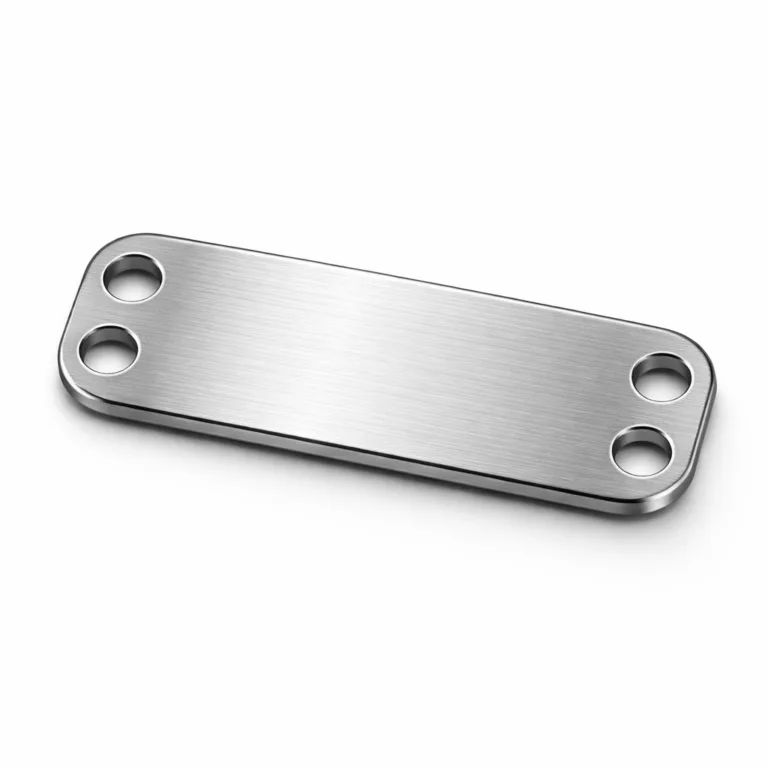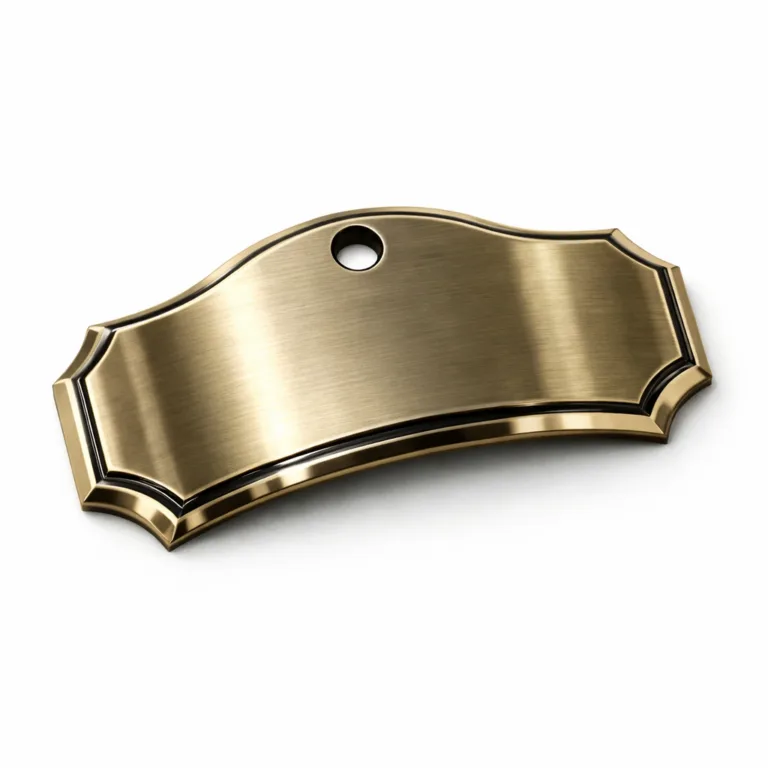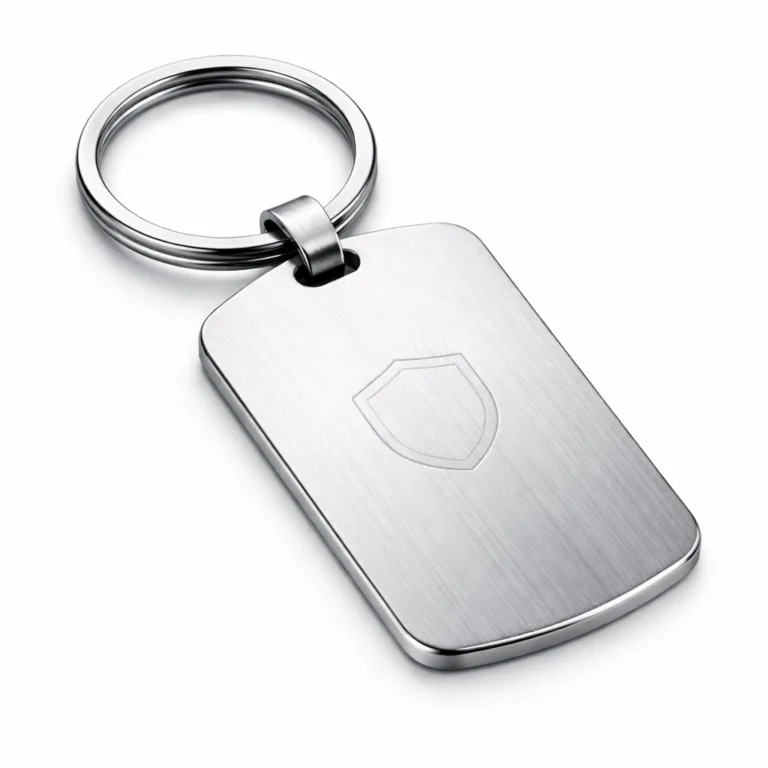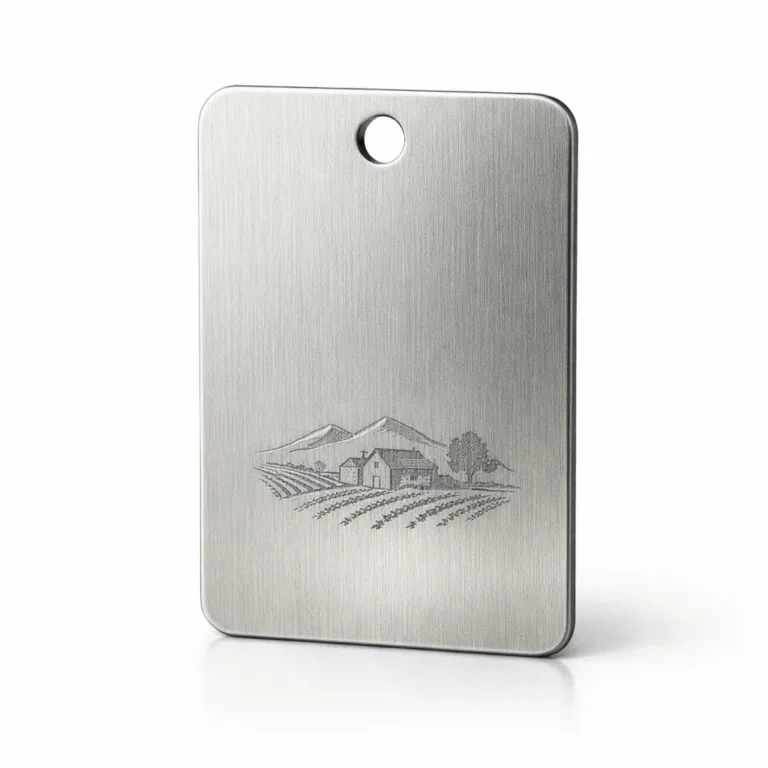
Small details carry a lot of weight in jewelry packaging. A box, pouch, card, or ribbon may already look refined, but a well-made metal tag can make the branding feel more permanent, tactile, and intentional. For buyers comparing metal tags for jewelry packaging, the main question is usually not whether metal looks premium. The real question is which material, finish, attachment method, and production detail will fit the packaging style without creating avoidable cost, assembly, or durability problems later.
If your project needs a decorative brand plate, a hanging logo charm, a small engraved mark, or a plated accent that must match packaging materials and brand positioning, our custom metal tag manufacturing solutions are built around those decisions. At UC Tag, we help buyers compare metal type, finish, logo process, attachment style, sampling, and bulk consistency so the tag works not only as a design element, but also as a practical packaging component for OEM, private label, and volume production.
What tiny metal tags add to jewelry packaging
Tiny metal tags are often used for logo display, collection naming, limited-edition presentation, authenticity cues, and decorative brand reinforcement. In jewelry packaging, they can appear on rigid boxes, drawer boxes, magnetic gift boxes, velvet pouches, ribbon ties, paper bags, hang cards, and care-card sleeves. Some brands want the tag to be the first visible element. Others want it to work quietly in the background and support a minimalist look.
From our manufacturing perspective, a small tag changes packaging in three important ways. First, it adds a hard, cool, reflective surface that contrasts with paper, fabric, leatherette, or coated board. Second, it improves tactile perception. Even when the tag is only a few centimeters wide, it gives the packaging a sense of permanence. Third, it makes the branding less dependent on ink alone. That matters when buyers want a logo element that feels collectible rather than disposable.
This is why many jewelry brands use metal tags not only for luxury presentation, but also for differentiation. A printed logo can look clean, but a metal tag can introduce depth, edge quality, weight, brushed grain, mirror polish, engraving lines, or plated color. Those details are easy to notice in the hand, especially during unboxing.
Why metal tags create a more premium unboxing experience
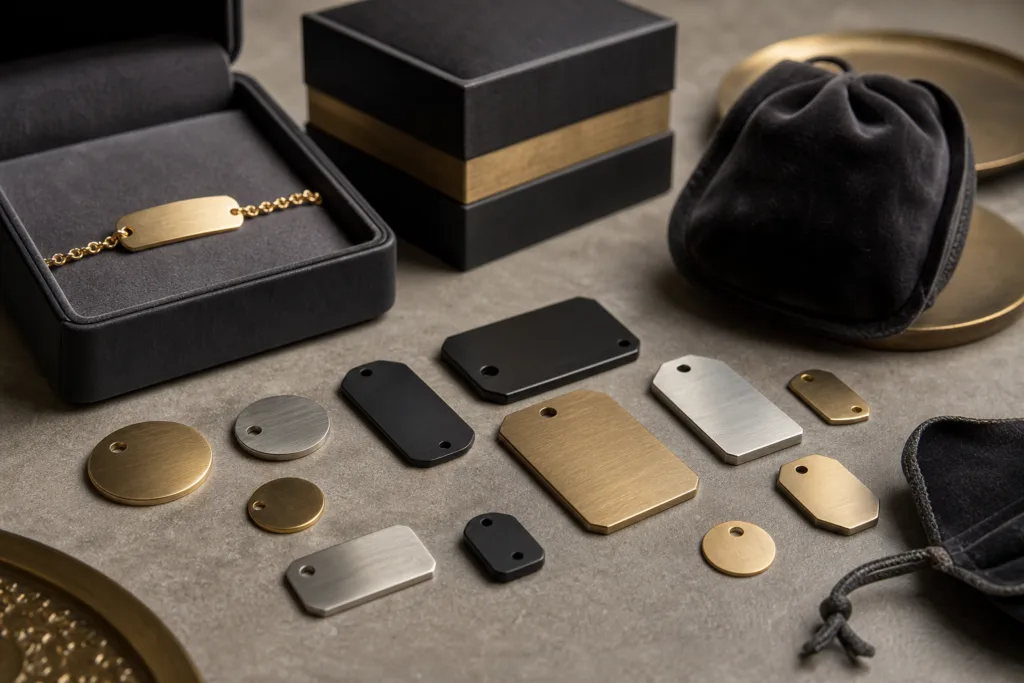
Premium packaging is not only about expensive materials. It is about how the parts work together. A jewelry customer may notice the texture of the box paper, the resistance of a magnetic flap, the softness of the pouch lining, and the way the logo catches light. A small metal tag contributes to that sequence because it creates a focal point.
For buyers, the key is to decide what role the tag should play. Some tags are meant to be a subtle signature. Others are meant to be a visible statement piece. If the packaging design is already visually busy, a simple brushed or matte metal tag often works better than a highly reflective plated tag. If the overall packaging is clean and monochrome, a polished or warm-toned metal detail can become the element that gives the box character.
In some projects, color control is part of the branding goal. When a logo plate needs a precise visual accent rather than bare metal only, buyers often compare engraving and print-based decoration. For this kind of work, UV printing for brand color effects can be useful on selected decorative packaging tags, especially when the goal is to retain a clean metal surface while adding controlled logo color, icon detail, or small graphic areas.
Best materials for metal tags for jewelry packaging
Material choice affects appearance, weight, price, scratch behavior, plating compatibility, and the way the tag interacts with the packaging substrate. In jewelry packaging, the tag usually does not face the same abuse as industrial equipment tags, but finish stability and presentation still matter. The best choice depends on whether the buyer prioritizes cost control, plating appearance, crisp engraving, or a higher-end natural metal feel.
Aluminum
Aluminum is light, easy to process, and suitable when the packaging needs a refined look without adding much weight. It works well for branded box plates, thin logo badges, and hanging decorative tags. Anodized versions can support color consistency and a clean surface appearance. The main consideration is that very soft aluminum can mark more easily than harder metals, so finish and thickness should be chosen carefully.
Stainless steel
Stainless steel suits brands that want a clean, modern, cool-toned appearance and better scratch and corrosion resistance. It is a strong option for minimalist jewelry packaging, especially when the design language is architectural or contemporary. It can be brushed, polished, etched, or engraved. Compared with softer materials, it usually gives a more stable premium feel over time, especially on reusable boxes or display packaging.
Brass
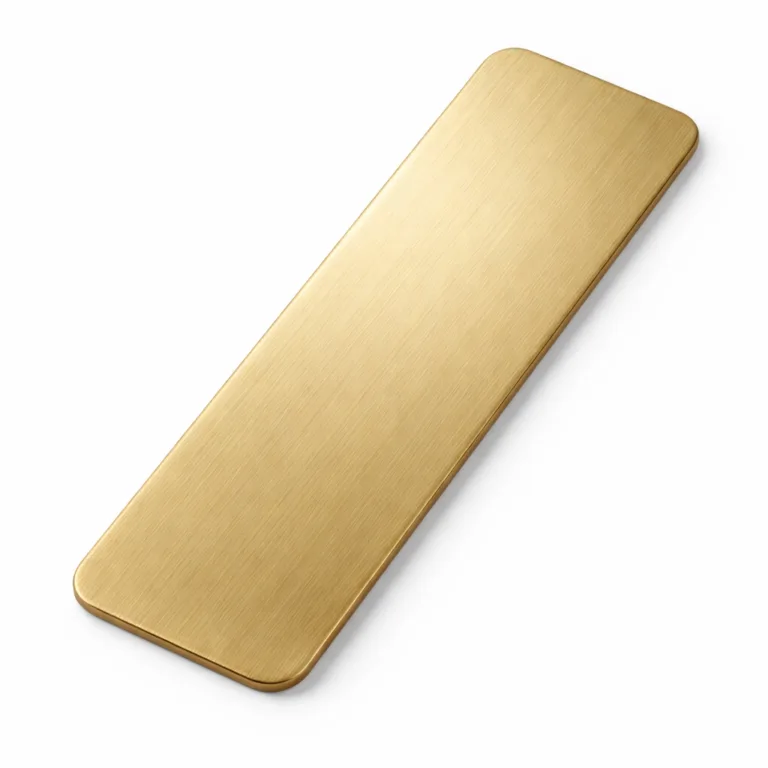
Brass is often chosen when buyers want warmth, classic luxury, or vintage character. It pairs well with dark paper, velvet, textured board, and leather-style surfaces. Brass can also be plated or coated, but even when it is not left in a raw appearance, its base material behavior can contribute to the overall decorative result. For jewelry brands aiming for heritage or boutique positioning, brass is often one of the most visually distinctive choices.
Zinc alloy and other decorative alloy options
When the design requires more dimensional forms, sculpted logos, thicker cast details, or irregular shapes, alloy-based decorative tags may be considered. These are useful when the tag is not just a plate but a small ornamental piece. The trade-off is that process flow, mold cost, and finish control may differ from sheet-metal tags. For medium to large branded packaging programs, this can still be worthwhile if the design effect is central to the brand identity.
| Material | Best Fit | Main Advantages | Things to Confirm Early |
|---|---|---|---|
| Aluminum | Lightweight logo plates | Low weight, good process flexibility, clean finish options | Scratch sensitivity, thickness, adhesive compatibility |
| Stainless steel | Modern premium packaging | Good rigidity, scratch resistance, refined appearance | Higher weight, edge treatment, cost target |
| Brass | Warm luxury branding | Rich tone, classic feel, strong decorative value | Tarnish management, coating choice, finish consistency |
| Alloy | Dimensional decorative tags | Complex shapes, embossed feel, ornamental effect | Mold planning, finish adhesion, unit economics |
Style and finish options that change the result
Buyers often focus on logo artwork first, but finish choice usually has just as much impact on the final look. A simple logo can look understated or dramatic depending on surface treatment. This detail may look small, but it can create problems later if it is not confirmed early. The same artwork on brushed stainless steel, polished brass, black anodized aluminum, and plated alloy will not communicate the same brand message.
Brushed, polished, and matte surfaces
Brushed finishes reduce glare and hide minor handling marks better than full mirror finishes. Polished finishes reflect more light and work well when the packaging is intended to feel glamorous or gift-oriented. Matte finishes help quiet the design and are often preferred by modern or minimalist brands. In practice, many jewelry buyers choose brushed or satin surfaces because they balance elegance with better day-to-day presentation stability.
Anodized, plated, engraved, etched, and printed effects
Anodized aluminum supports colored surfaces with a controlled metallic base. Plated finishes are often selected for gold-tone, rose-gold-tone, silver-tone, gunmetal, or other fashion-oriented looks. Engraving removes or cuts into the surface and gives a durable, tactile mark. Chemical etching allows crisp recessed detail for logos and fine graphics. Printing is useful when the design requires small color areas, but the suitability depends on how the packaging will be handled and how long the decorative effect needs to remain pristine.
Some jewelry brands specifically want warm decorative surfaces that look close to hardware used in the jewelry itself. In those cases, plated decorative pieces such as gold-plated logo tags are often considered because the visual harmony between the packaging accent and the jewelry style can be stronger than with plain silver-tone metal.
Finish performance is not only about beauty. Surface cleaning, pretreatment, coating choice, and process control all affect how the finish holds up. Even decorative tags benefit from sound finishing logic, and the role of cleaning and coating preparation in long-term appearance is well understood in broader corrosion-resistant metal finishing practice.
Customization possibilities for brand identity
The design space for tiny packaging tags is wider than many buyers expect. Beyond a basic rectangle with a logo, a tag can include custom contour shapes, rounded corners, cutouts, layered structures, textured fields, serial numbering, slogan text, or collection marks. For packaging teams, the best result usually comes from simplifying the visual hierarchy. A small tag should not try to carry too much information.
On jewelry packaging, we usually recommend deciding first whether the tag is decorative, informative, or both. If it is decorative, logo clarity and finish quality matter most. If it also needs data such as a short series mark, limited-edition number, or authentication cue, then artwork spacing and font size become more critical. Small tags can still hold detailed information, but readability depends on line weight, contrast, and production method.
At UC Tag, we often guide buyers to start with four design variables before sampling: overall size, visible thickness, edge style, and logo method. Once those are stable, it becomes much easier to confirm attachment choice, plating tone, protective coating, and assembly logic. In many projects, the problem is not that the buyer chose the wrong category. The problem is that some production details were not clarified before sampling or bulk production.
How to match metal tag design with jewelry box materials and brand aesthetics
A metal tag should work with the packaging material, not fight it. A thick polished tag on a small soft-touch paper box can look too heavy. A very thin matte plate on a rigid luxury drawer box may disappear too much. The balance between substrate texture, box size, and tag weight should be considered together.
Here is a practical way to match the tag to the packaging style:
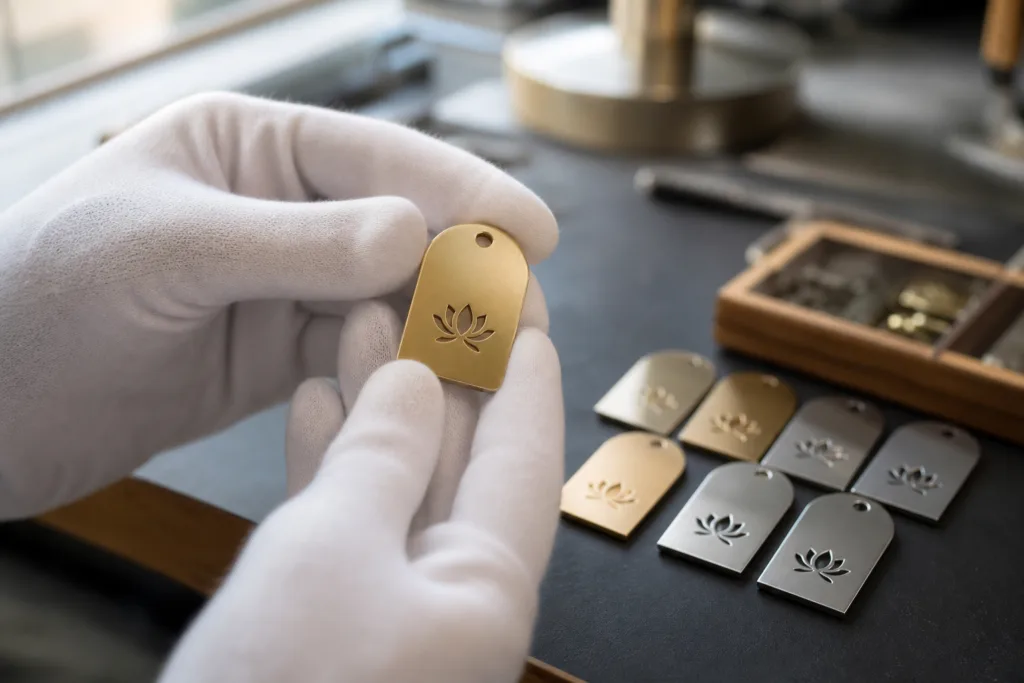
- Luxury classic brands: warm metals, brass tones, subtle polish, engraved or etched logos, centered placement.
- Minimalist brands: stainless steel or anodized aluminum, brushed or matte finish, thin profile, simple geometry.
- Modern fashion brands: mixed finishes, black or gunmetal tones, geometric shapes, color accents, side placement.
- Natural or sustainable brands: lighter metal usage, restrained finish systems, recyclable packaging compatibility, simplified assembly.
If the box surface has visible grain, texture, embossing, or fabric wrapping, the tag size should be checked against those visual features. A logo plate that looks correct on plain artwork can feel crowded once it sits on a textured box panel or next to foil stamping and ribbon details.
Attachment methods for packaging tags
Attachment method is one of the most overlooked decisions in decorative packaging projects. Buyers may approve the tag appearance, then discover later that assembly is slow, adhesive placement is inconsistent, or the box material cannot support the chosen fixing method cleanly.
Adhesive backing
Adhesive-backed tags are common for jewelry boxes because they keep the appearance clean and avoid visible fasteners. This method is efficient when the box surface is flat, smooth, and stable. The important details are adhesive type, surface energy of the substrate, storage conditions, and whether manual or semi-automatic assembly will be used.
Rivets, pins, and decorative hardware
These methods create a more permanent and crafted look, especially on thicker board structures, leather-style boxes, and reusable presentation cases. They can be visually strong, but hole position tolerance and backside construction need to be planned early.
Threads, ribbons, and hanging styles
For pouches, cards, and gift wrapping, a hanging tag can function like a small charm. This gives flexibility and often improves the gift feel, but the hole size, edge smoothness, and hanging component color must all be coordinated. A tag that looks elegant on its own may look unfinished if the cord, thread, or ring is not matched properly.
| Attachment Method | Good For | Advantages | Watch Points |
|---|---|---|---|
| Adhesive backing | Rigid box lids and sleeves | Clean look, efficient assembly | Surface prep, adhesive grade, placement jig |
| Rivets or pins | Reusable boxes and leatherette | Permanent feel, decorative structure | Hole accuracy, backside finish |
| Thread or ribbon hang | Pouches, cards, gift wraps | Flexible styling, charm-like effect | Hole size, cord quality, swing movement |
Durability considerations for presentation and repeat handling
Jewelry packaging tags are decorative, but they still need to survive assembly, transport, retail handling, and customer use. The main concerns are scratch visibility, tarnish risk, finish adhesion, and edge quality. A premium look can be lost quickly if the surface marks too easily or if the plating tone changes unevenly in storage.
For brass and plated components, buyers should confirm whether a clear protective layer is needed based on the target look and storage environment. For stainless steel, the focus is often on achieving the right visual polish while maintaining clean edge quality. For aluminum, buyers should think about thickness and finish hardness together. The thinner and softer the part, the more visible handling marks may become.
On packaging projects with global shipping, it is also worth checking how the tags will be packed before final assembly. Even a well-finished tag can arrive with avoidable abrasions if bulk inner packaging is not designed carefully. Small separators, protective films, tray organization, and count control often matter more than buyers expect.
Sustainable sourcing and eco-friendly packaging choices
Sustainability in jewelry packaging is usually discussed in terms of paper, inserts, and plastics, but the metal detail should be evaluated as well. If the brand message includes responsible packaging, the tag should align with that claim in a practical way. That does not mean every project needs a complicated environmental story. It means the material, finish, and assembly should make sense for reuse, recyclability, and safer chemistry considerations.
In our packaging-related projects, we usually advise buyers to look at three areas: whether the metal component can incorporate recycled input where appropriate, whether decorative coatings align with safer material choices, and whether the way the tag is attached makes the packaging easier or harder to separate by material at end of life. Guidance around sustainable metal tag sourcing is most useful when it is tied to actual design choices rather than broad claims.
For brands that want a more evidence-based framework, it is helpful to review principles related to recycled-content and safer packaging materials, especially when coatings, heavy-metal concerns, or supplier declarations are part of the conversation. From a packaging system viewpoint, broader concepts in packaging material recycling also support the idea that attachment method and material compatibility should be considered early, not after the tag design is finished.
A simple example is this: if a box is intended for long-term reuse, a durable attached tag may support the brand’s value well. If the packaging is designed for easier material separation, then adhesive choice, removability, and mixed-material complexity may deserve more attention. Sustainable design is not only about which metal is used. It is also about whether the component fits the life cycle of the packaging.
Practical design tips for luxury, minimalist, and modern jewelry brands
Luxury brands usually benefit from restraint. A small, well-proportioned tag with good edge finishing often feels more expensive than a larger tag with too many effects. Minimalist brands should pay close attention to line thickness and spacing. On a very small metal plate, a crowded logo can look softer than expected after finishing. Modern brands can be more experimental with asymmetry, black finishes, mixed textures, or selective color, but those choices still need to be production-friendly.
We also suggest checking the tag at actual viewing distance. Buyers sometimes approve enlarged artwork on a screen, but the real packaging is judged in the hand. That is why custom metal tag sampling matters so much. A sample helps verify size balance, finish reflection, adhesive performance, edge feel, and whether the branding still reads clearly on the final packaging material.
Common mistakes to avoid
- Choosing size by artwork only: the tag should be sized against the full packaging panel, not the logo file alone.
- Ignoring edge feel: on hand-held packaging, rough or sharp-feeling edges can reduce perceived quality.
- Overloading small tags with text: too much content weakens readability and visual impact.
- Confirming finish without substrate review: a beautiful finish can still look mismatched on the actual box texture or color.
- Underestimating assembly method: adhesive, rivet, or hanging style can affect labor, consistency, and final presentation.
- Skipping packaging for the tags themselves: decorative surfaces need protective packing before assembly.
Supplier evaluation checklist for custom metal tag production
When buyers compare suppliers for jewelry packaging tags, product photos are not enough. The better questions are about process fit and production control. Can the supplier explain which metal and finish combination suits the packaging style? Can they advise on logo method based on detail size? Can they handle color or plating consistency? Can they support sample revisions before mass production? Can they organize the tags in a way that helps assembly teams work efficiently?
From a manufacturer guide standpoint, these are the checkpoints worth confirming:
- Available materials, thickness range, and finish options for small decorative tags
- Logo methods suitable for fine details and small dimensions
- Attachment options based on box, pouch, ribbon, or card application
- Sample approval process and revision handling
- Bulk packing method to reduce scratches and count errors
- Lead time logic for plain, plated, engraved, or color-decorated tags
- QC checkpoints for size, hole position, finish consistency, and branding clarity
- Support for OEM, private label, and branded packaging development
Conclusion
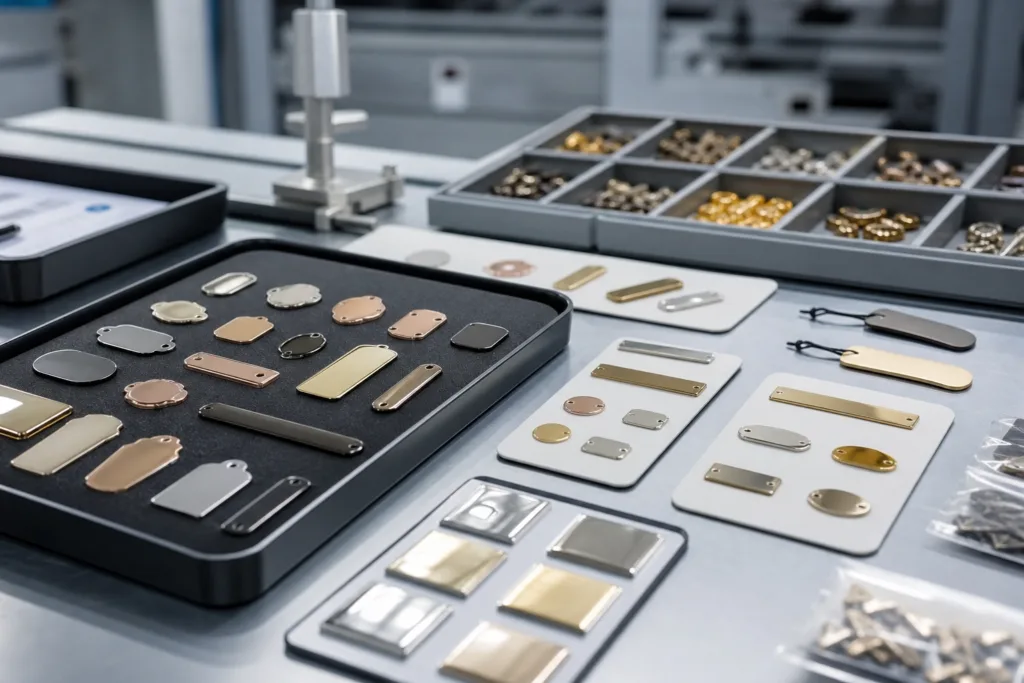
Tiny metal tags can do much more than add decoration. When they are specified well, they improve brand recognition, strengthen unboxing quality, and help a jewelry box or pouch feel more considered and lasting. For buyers evaluating metal tags for jewelry packaging, the best result usually comes from balancing visual style with practical production details: the right metal, the right finish, the right attachment, and the right sample review process. A small tag may be a minor component in cost terms, but it can have a major effect on how the packaging is experienced.
FAQ
What size works best for jewelry packaging metal tags?
The right size depends on the box or pouch scale, the logo complexity, and whether the tag is meant to be a focal point or a subtle accent. For most jewelry packaging, buyers should first test a size that leaves enough quiet space around the tag rather than filling the panel. A small tag often looks more premium when it is proportionate and clean. We usually recommend checking actual mockups on the final packaging material because screen layouts alone can make a tag look smaller or larger than it will feel in the hand.
Which material is best for a premium jewelry box tag?
There is no single best option for every brand. Stainless steel works well for clean, modern packaging and better scratch resistance. Brass suits warm, classic, or boutique-style branding. Aluminum is useful when low weight and flexible finishing are priorities. If the design needs a thicker ornamental look, alloy-based options may fit better. The decision should be based on visual style, finish target, handling expectations, and budget, not only on the material name.
Are engraved or printed tags better for packaging logos?
Engraved tags are usually preferred when buyers want a tactile, durable, and more permanent brand mark. Printed tags are useful when color accuracy, small graphic elements, or a softer decorative look are more important. For jewelry packaging, the better choice depends on whether the logo should feel like part of the metal itself or whether the project needs controlled brand color. In small-format tags, artwork line weight and contrast should always be checked before final approval.
How should metal tags be attached to jewelry boxes or pouches?
Adhesive backing is common for rigid jewelry boxes because it gives a clean appearance and supports efficient assembly. Threads, ribbons, or jump-ring hanging styles are often better for pouches and cards. Rivets or pins can create a more permanent hardware-like effect on reusable presentation boxes. Buyers should confirm attachment method early because it affects labor, substrate compatibility, positioning accuracy, and the overall feel of the packaging.
What should we prepare before sampling and bulk production?
You should prepare logo artwork in a usable vector format, target size, finish preference, attachment method, placement reference, packaging material details, and any special requirements for color, plating tone, or protective packing. It also helps to explain whether the tag is decorative only or whether it needs extra text or numbering. The more clearly those points are defined before sampling, the faster the sample stage will move and the fewer changes will be needed before bulk production.
What affects MOQ and lead time for custom jewelry packaging tags?
MOQ and lead time are usually affected by material choice, finish complexity, plating requirements, custom shape, thickness, logo process, and whether new tooling is needed. Simple flat tags with standard processes are normally easier to schedule than highly customized plated or dimensional pieces. Sampling, artwork revisions, and special packaging for scratch protection can also affect timing. For buyers, the practical step is to separate must-have design features from optional ones before quoting, because that makes production planning much clearer.