Promotional keychains look simple, but for marketing buyers the real question is whether they create enough long-term visibility to justify the spend. When people search for promotional products cost per impression keychains, they usually want more than a rough promo-products rule of thumb. They want a practical way to calculate total campaign cost, estimate real impressions, compare different keychain styles, and decide whether the item supports brand awareness, engagement, or response goals.
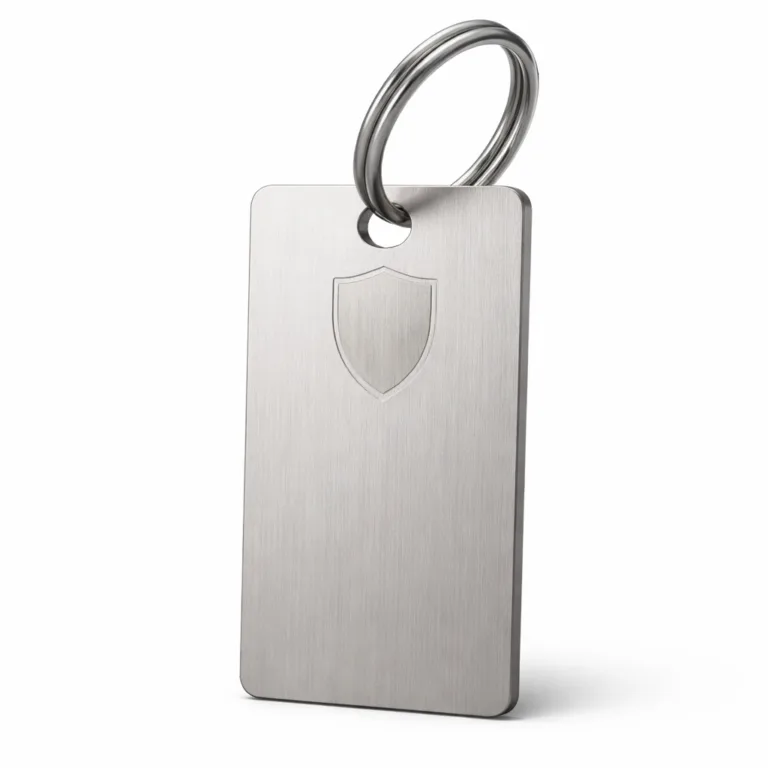
If your campaign needs a durable item that stays in daily use, custom keychain tag manufacturing support matters early in the planning stage. In our production work, we often help buyers compare materials, engraving or printing methods, attachment structures, QR or serial data options, sample approval steps, and packaging choices so the final keychain is not just attractive at delivery, but practical enough to keep generating impressions after distribution.
What promotional keychains can do for brand awareness and customer engagement
A keychain has one major advantage over many short-life promotional items: it can stay with the user for months or years if the format is useful. That makes it different from a flyer, insert card, or one-time giveaway that disappears quickly. A keychain can travel with house keys, car keys, locker keys, office access cards, or bags. Every time it is picked up, set down, clipped on, or noticed by someone else, it creates a possible impression.
From our manufacturing perspective, the campaign result usually depends less on the word “keychain” itself and more on the combination of structure, durability, branding method, and audience fit. A cheap item that bends, fades, or feels awkward may produce very few impressions because it is discarded early. A well-made item that solves a small daily-use need can keep working long after the event is over.
This is why keychains are often considered in trade shows, dealer programs, dealership handouts, hospitality branding, utility outreach, campus campaigns, loyalty gifts, and product-launch kits. They are small, easy to pack, and scalable for volume distribution. But buyers still need a clean ROI framework instead of assuming every giveaway performs equally.
Why cost per impression matters in promotional product evaluation

Cost per impression helps buyers compare a physical promo item against other awareness tools. It is not a complete ROI metric on its own, but it is a useful starting point because it answers a simple question: How much are we paying each time the brand is likely seen?
For procurement and marketing teams, this matters in three ways:
- It creates a common decision framework across item types.
- It helps justify budget internally when the campaign goal is awareness rather than immediate sales.
- It makes it easier to compare a higher-cost durable keychain with a lower-cost disposable item.
In many projects, the mistake is comparing only unit price. A $0.60 keychain that gets discarded in a week may be less efficient than a $1.20 keychain that stays in use for a year. For buyers, the key is not only the product name or price, but whether the material, structure, marking method, and audience need match the real campaign objective.
How to define an impression for a keychain campaign
One reason buyers struggle with promotional item ROI is that an “impression” is not as precise as a digital ad impression. For a keychain campaign, an impression is usually an estimated instance in which the branded item is seen by the recipient or by another person nearby.
A practical definition can include:
- The owner seeing the keychain during daily use
- Someone nearby noticing it on a desk, bag, counter, key ring, or vehicle key set
- A scan or interaction triggered by a visible QR code or message
You should define your impression model before doing the math. For example:
- Conservative model: 1 to 2 impressions per day
- Moderate model: 3 to 5 impressions per day
- Active-use model: 5+ impressions per day for frequently handled key sets or bottle opener styles used in hospitality or events
Retention matters here. Useful items tend to stay in circulation longer, which is why research on consumer retention and repeat exposure for promotional products is relevant when estimating lifetime impressions. The item has to be kept and used before it can become cost-efficient.
Step-by-step formula for calculating cost per impression
The basic formula is straightforward:
Cost Per Impression = Total Campaign Cost ÷ Total Estimated Impressions
To make that useful, break it into steps.
Step 1: Calculate total campaign cost
Add all direct campaign costs, not just the quoted unit price.
Step 2: Estimate the number of distributed units that actually stay in use
Not every item handed out becomes an active-use item. Some are lost, ignored, or discarded.
Step 3: Estimate impressions per item per day or per week
Use a conservative, moderate, or active-use assumption based on the audience and item type.
Step 4: Estimate useful life
How long will the item likely remain in circulation: 30 days, 6 months, 1 year, or longer?
Step 5: Multiply active units by impressions over useful life
Total Estimated Impressions = Active Items × Impressions Per Period × Number of Periods in Use
Step 6: Divide total cost by total impressions
This gives you the estimated cost per impression.
Example:
- 5,000 keychains ordered
- Total campaign cost: $6,500
- Estimated active-use rate: 70%
- Active units: 3,500
- Estimated impressions per day: 3
- Estimated useful life: 180 days
Total impressions = 3,500 × 3 × 180 = 1,890,000
Cost per impression = $6,500 ÷ 1,890,000 = $0.0034 per impression
This number is not exact science, but it gives buyers a structured way to compare options.
Which costs to include in the calculation
This detail may look small, but it can distort the result if it is not confirmed early. Buyers often underestimate campaign cost because they use only the supplier’s base unit quote.
Include these cost elements where relevant:
- Base unit price
- Mold or tooling cost for custom shapes
- Engraving, stamping, printing, enamel fill, or plating upgrades
- Individual packaging or retail cards
- Barcode labels or variable data handling
- Sampling and approval cost
- Freight, import, local delivery, and event distribution cost
- Fulfillment labor if items are packed into kits
- Design or artwork preparation cost if charged separately
At UC Tag, we usually advise buyers to separate product cost from campaign deployment cost. That helps when comparing a simple in-bulk handout versus a more premium packaged campaign. The item may be the same, but the distribution model changes the economics.
How to estimate the number of impressions a keychain can generate
The most practical approach is to estimate from behavior, not from wishful thinking. Ask four questions:
- How useful is the keychain in daily life?
- How visible is the logo or message during normal use?
- How durable is the material and marking?
- How well does the style fit the audience?
A compact keychain that holds keys comfortably may stay in use longer than an oversized decorative piece. A metal keychain with clean branding may survive pocket wear better than a low-cost printed plastic version. A bottle opener format may get more social visibility in hospitality or beverage promotions than a plain charm tag.
Useful life estimates can be grouped like this:
| Keychain type | Likely use pattern | Estimated useful life for CPI model |
|---|---|---|
| Basic low-cost giveaway | Event handout, uneven retention | 30 to 90 days |
| Functional branded keychain | Daily keys or access use | 6 to 12 months |
| Durable metal keychain | Long-term carry item | 12 months or more |
| Bottle opener or utility style | Repeated practical use | 6 to 18 months |
| Premium leather or gift-style | Selective audience, higher retention | 6 to 24 months |
The exact number depends on your market. A student event, dealership service campaign, industrial brand promotion, and hospitality program will all behave differently.
What makes one keychain more cost-effective than another
Cost-effective does not always mean cheapest. In real projects, the better value option is the one that creates more retained use and more visible branding per dollar spent.
Factors that usually improve cost efficiency:
- Useful format people actually keep
- Durable material that does not crack, bend, or fade quickly
- Readable branding that survives abrasion
- Comfortable size and weight for daily carry
- Audience-specific design rather than generic decoration
- Efficient packaging and distribution
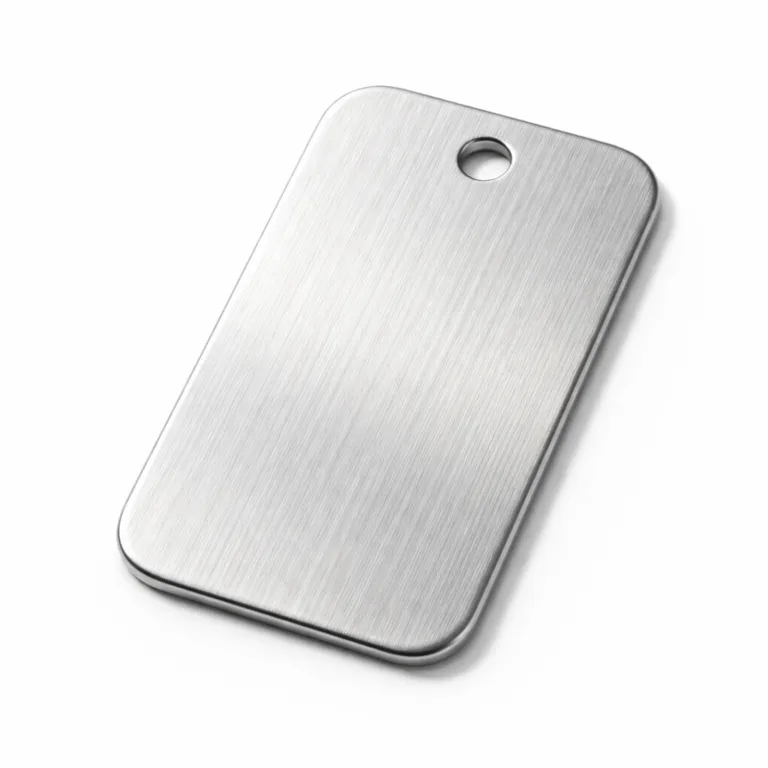
For example, buyers comparing metal keychain tag options against lighter plastic formats should not stop at unit price. They should compare retention, scratch visibility, edge quality, branding permanence, and the chance that the item will remain attached to an active key set.
Material and style comparison for promotional keychains
Different materials create different cost-per-impression outcomes because they affect durability, perceived value, and use frequency.
| Material or style | Strengths | Limitations | Best fit |
|---|---|---|---|
| Metal | Durable, premium feel, strong branding permanence | Higher unit cost, heavier | Longer-term brand visibility, dealership, industrial, membership, gifting |
| Plastic | Low cost, easy for high-volume giveaways | Lower perceived value, shorter life in some campaigns | Large event handouts, price-sensitive campaigns |
| Leather or PU | Premium look, lifestyle feel | Can wear differently by environment, sometimes less suitable for hard industrial use | Hospitality, automotive, boutique branding |
| Acrylic | Colorful, flexible design shapes | May scratch or crack depending on thickness and use | Youth campaigns, creative brand launches |
| Bottle opener | Functional, social-use visibility, repeated interaction | Needs the right audience and use context | Beverage, events, hospitality, outdoor promotions |
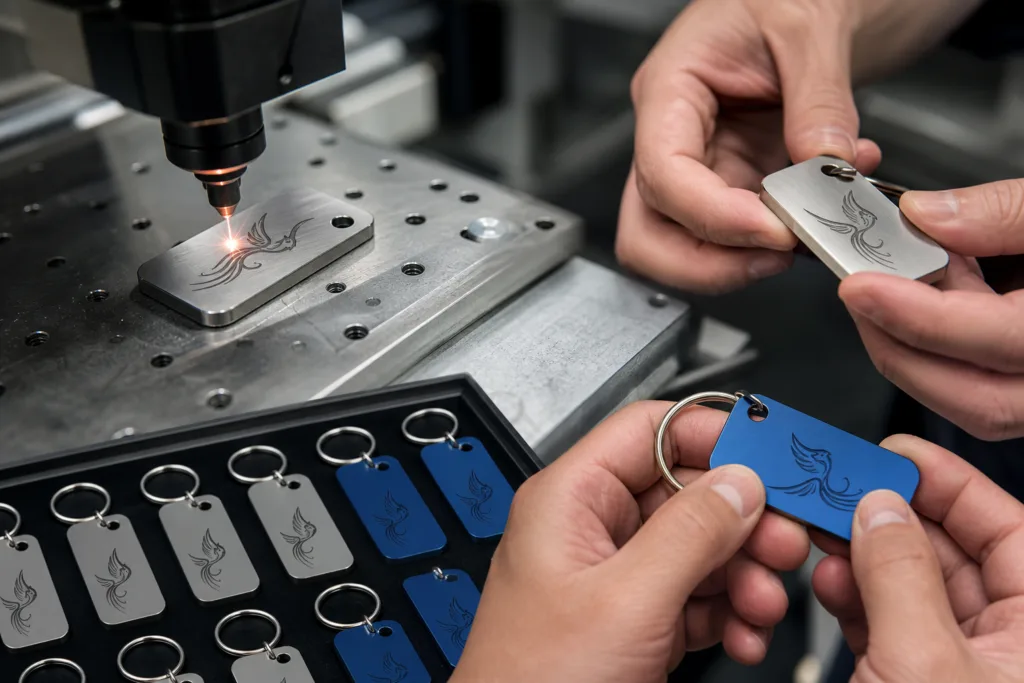
For buyers who want durable branding rather than low upfront cost only, our experience is that marking method matters almost as much as material. Clean engraved keychain customization generally holds up better than surface-only decoration when the item will see pocket friction and regular handling.
How design, durability, and daily use affect visibility and retention
A keychain can be well made and still perform poorly if the design is awkward. Daily-use products succeed when they fit naturally into the user’s routine.
Here is what usually improves visibility and retention:
- Rounded edges and comfortable thickness
- A logo area large enough to stay readable
- Brand contrast that remains visible in normal light
- A ring or attachment that feels secure
- A shape that does not snag or create pocket bulk
- A feature with real utility, such as opening bottles, holding tokens, or carrying a short message or QR code
Quality also influences whether the recipient keeps the item. Industry research about durability, tactile quality, and keep-vs-discard behavior supports what many buyers already suspect: usefulness and feel affect whether a promo item survives beyond the first impression.
This is one reason promotional bottle opener keychains can perform well in the right campaign. Their value is easy to understand immediately, so the item is more likely to stay in circulation than a purely decorative giveaway.
Choosing the right keychain for your brand values and target audience
The right keychain for a luxury brand is not the same as the right keychain for a utility company, trade show distributor, or campus program. Buyers should match the item to the audience and the brand message.
Ask these questions before approving production:
- Is the campaign aiming for awareness, appreciation, recall, or direct response?
- Will recipients carry this item every day or only occasionally?
- Does the brand need a premium appearance or a volume-first budget approach?
- Should the branding be subtle, highly visible, or data-driven with a QR code?
- Is the audience likely to value utility, style, novelty, or durability?
In our custom project work, brand fit usually matters more than visual complexity. A simple shape in the right material often outperforms an overdesigned piece that looks interesting at the event but does not stay on a key ring.
Examples of keychain campaigns that tend to work
Let’s look at what actually affects the result.
Trade show lead-generation keychain
A company distributes a compact metal keychain with a QR code linked to a product page and a show-only offer. The item works because it is easy to keep, the scan path is clear, and the landing page is trackable. The ROI comes from both awareness and measured visits.
Dealership service reminder keychain
An automotive business gives customers a branded engraved keychain after service. The item reinforces recall every time the keys are used. If a service code or return reminder is included, the campaign can support repeat visits.
Hospitality beverage promotion
A beverage or venue brand uses a bottle opener keychain in event kits. This works when the audience is likely to use the function repeatedly in social settings, creating both owner and bystander impressions.
Membership or loyalty gift
A branded metal tag keychain can support community identity when the finish and message feel intentional rather than disposable. This format is often more about retention and brand sentiment than immediate direct response.
How to measure ROI beyond impressions
Impressions are useful, but campaign ROI should also include action. A keychain campaign can support multiple measurable outcomes:
- Leads captured after event distribution
- Website visits from QR codes or short URLs
- Promo code redemption
- Dealer or branch inquiries
- Repeat purchases or service visits
- Survey-based brand recall
A practical ROI formula is:
ROI = (Campaign Return – Total Campaign Cost) ÷ Total Campaign Cost
If direct revenue is hard to isolate, you can use a blended measurement model:
- Awareness metric: estimated impressions
- Engagement metric: scans, visits, or code use
- Sales metric: leads, inquiries, orders, or repeat purchases
This gives marketing teams a more realistic view of physical promotional performance.
Tracking methods for campaign performance
If you want a stronger result than “we handed them out and people seemed to like them,” build tracking into the item or the campaign flow.
Useful tracking methods include:
- QR codes linked to a campaign-specific landing page
- Promo codes tied to a specific event or channel
- Short URLs with campaign naming
- Survey questions asking where the recipient received the item
- Branch-specific or distributor-specific code versions
For digital attribution, use trackable landing pages and UTM campaign tags so visits and conversions can be separated by event, audience, or distribution batch. If buyers want more customized shapes, branding structures, or integrated campaign features, this is also where OEM and ODM tag development becomes useful because the keychain can be designed around the campaign objective rather than chosen from a standard catalog format.
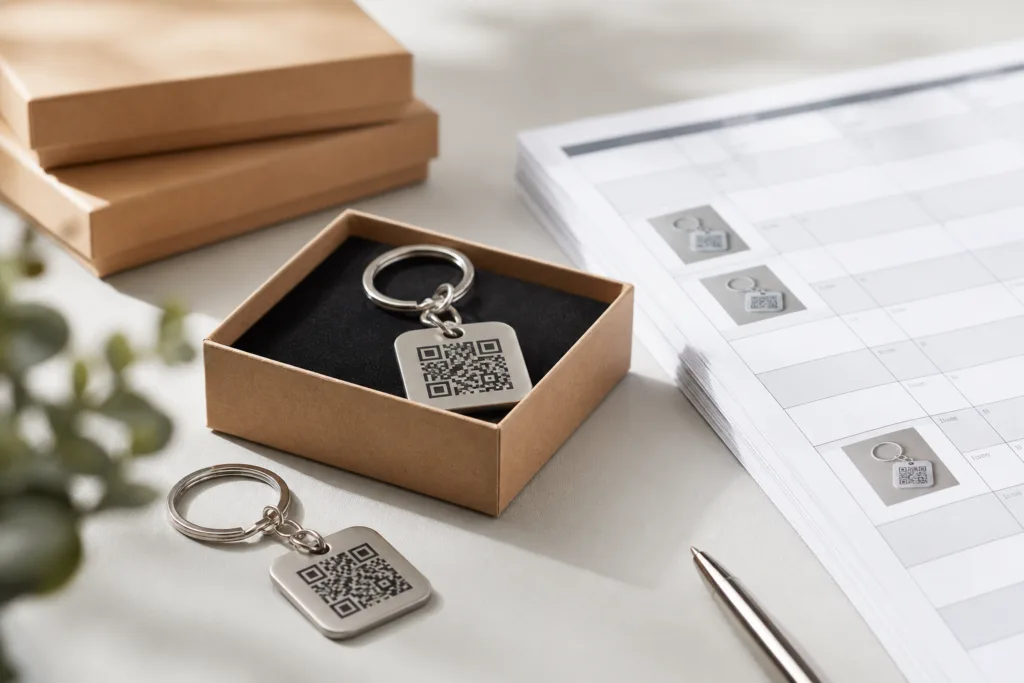
In the middle of production planning, it is also worth discussing whether the QR code size, placement, and contrast will remain scannable after finishing and daily wear. This is a common point that should be confirmed during sampling, not after the bulk run is packed.
From our manufacturer perspective at UC Tag, sample approval is where many ROI problems can be prevented. A few millimeters of logo area, a better edge finish, a different engraving depth, or a stronger attachment ring can change whether the item stays useful and visible in the field.
Common mistakes that distort cost per impression calculations
In many projects, the problem is not that the buyer chose the wrong category. The problem is that some production details were not clarified before sampling or bulk production.
- Using base unit cost only: This ignores packaging, freight, setup, and fulfillment.
- Overestimating useful life: If the keychain is low quality or irrelevant to the audience, the impression count is inflated.
- Assuming all distributed units are active: Distribution does not equal adoption.
- Ignoring branding durability: If print fades quickly, later impressions may have little value.
- No response tracking: Without QR codes, promo codes, or landing pages, ROI remains mostly guesswork.
- Choosing novelty over daily utility: Interesting items may not stay in use.
Buyers should also avoid comparing campaigns with different audience quality. A lower CPI campaign is not automatically better if the recipients are poorly matched and generate no meaningful engagement.
How to decide whether promotional keychains are the right investment
Promotional keychains are usually a strong fit when your campaign needs low-friction distribution, repeat visibility, and a practical item with a reasonable budget profile. They are less suitable when the audience is unlikely to carry keys, when the brand needs a high-tech premium gift, or when the campaign demands immediate measurable conversion with no delay.
A keychain campaign is more likely to make sense when:
- You need a long-use awareness item
- The audience values practical everyday carry products
- The logo or message can remain readable on a small format
- You can build in a tracking element such as a QR code or promo code
- You have enough volume to spread setup costs efficiently
It is less likely to be the right investment when:
- The audience has little need for another keychain
- The branding requires too much message space
- The item quality target and budget are badly mismatched
- The campaign success depends only on immediate direct conversion
For buyers evaluating promotional products cost per impression keychains, the key is to combine simple math with realistic usage assumptions. A keychain is not valuable because it is inexpensive. It is valuable when people keep it, use it, notice it, and act on the message attached to it.
Conclusion
The practical way to evaluate promotional keychains is to start with total campaign cost, estimate active-use retention, calculate realistic lifetime impressions, and then add response tracking for scans, visits, leads, or repeat orders. When buyers do this well, they can compare not just prices, but actual campaign efficiency. From our manufacturing side, the biggest performance drivers are usually utility, material choice, branding durability, and audience fit. If you are reviewing promotional products cost per impression keychains for your next campaign, focus on the item’s real-life staying power as much as the quote.
FAQs
What is a good cost per impression for promotional keychains?
A good number depends on your audience, distribution quality, and how long the item stays in use. In practice, buyers should compare campaigns using the same impression model rather than chasing one universal benchmark. A slightly higher upfront cost can still be efficient if the keychain has stronger retention, better daily use, and more durable branding.
How do I calculate impressions for a keychain if I do not have usage data?
Start with a conservative estimate based on expected daily handling and likely useful life. For example, assume only a portion of recipients keep the item, then apply a modest daily impression range over 30, 90, or 180 days. It is better to understate assumptions and refine them later with survey feedback or campaign response data.
Are metal keychains better for ROI than plastic keychains?
Not automatically. Metal keychains often offer better durability and perceived value, which can improve retention and long-term impressions, but they also cost more. The better ROI choice depends on audience fit, campaign goal, use frequency, and whether the extra durability actually increases the number of active-use days enough to justify the higher cost.
Should I add a QR code to a promotional keychain?
If the campaign needs measurable response, a QR code can be useful, but only if the code is large enough, placed clearly, and linked to a relevant landing page. For very small keychains, the design has to balance scan reliability with logo visibility. This should be checked during sampling so the code remains practical after finishing and daily wear.
What costs do buyers most often forget in keychain ROI planning?
The most commonly missed items are setup or tooling, packaging, freight, local distribution, sampling, and fulfillment labor. Some buyers also forget to count the cost of artwork revision, variable data handling, or campaign landing-page setup. Missing these items can make the cost per impression look much better on paper than it is in the full campaign budget.
How can I improve the ROI of a promotional keychain campaign?
Improve ROI by choosing a format people will actually keep, using durable branding, keeping the design easy to read, matching the item to the audience, and adding a clear tracking method such as a QR code or promo code. Better sample review, stronger distribution targeting, and realistic packaging choices can also improve campaign efficiency without changing the product category.