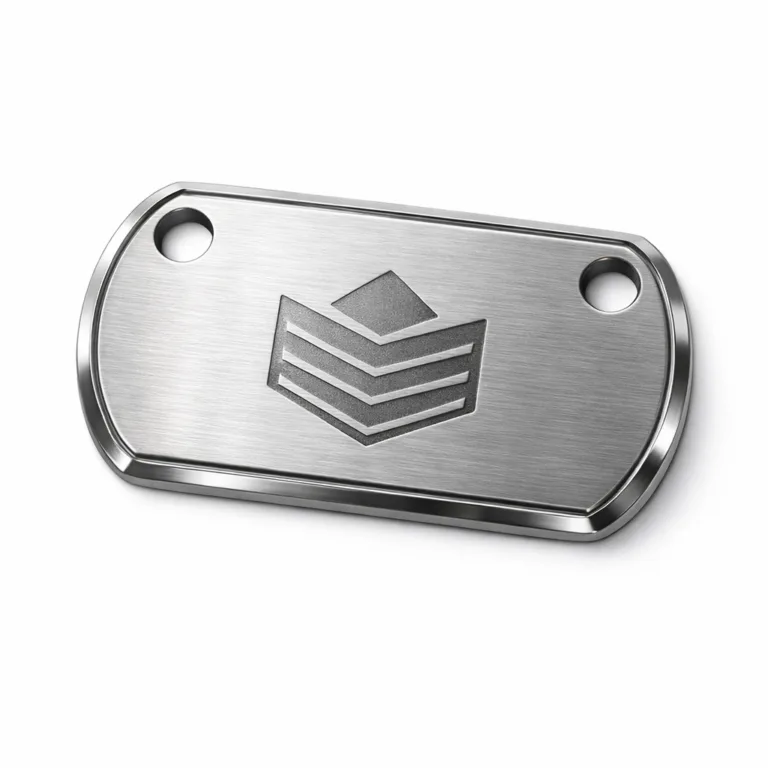
Introduction to Bulk Discounts
Bulk discounts are a cornerstone strategy in manufacturing procurement, especially for businesses sourcing durable metal tags. In simple terms, bulk discounts are price reductions offered when ordering larger quantities. This practice allows buyers to lower their per-unit cost, which can have a substantial impact on overall project budget and supply chain planning.
At the heart of bulk discounts are quantity thresholds—predetermined order levels that trigger pricing breaks. For instance, ordering 100 tags might cost more per piece than ordering 1,000 or 10,000, as each threshold unlocks deeper discounts. These thresholds aren’t standardized and can fluctuate dramatically between sectors: electronics, automotive, and heavy industry buyers may see breaks at one level while consumer goods or apparel see them at another.
The significance of bulk discounts goes beyond just cost savings. Negotiating these discounts is a key part of strategic purchasing, as it can strengthen supplier relationships and unlock value in long-term projects. This is especially vital for companies sourcing durable metal tags—products that demand repeat orders for identification, branding, and compliance.
Key Factors Influencing Bulk Pricing

Several core elements shape the way suppliers approach bulk discounts. Understanding these factors can help buyers align expectations and negotiate more effectively. The most common pricing models include:
- Cost-plus pricing: The supplier calculates the total production cost and adds a set margin. Bulk orders drive down per-unit costs, allowing for larger discounts.
- Competitive pricing: Suppliers review market rates and aim to offer attractive pricing relative to competitors, often adjusting bulk discount levels in response to industry trends.
Market competition also drives bulk discount offerings. When multiple suppliers compete for large contracts, buyers often see greater willingness to negotiate on quantity thresholds and overall rates. Conversely, in highly specialized or low-competition sectors, discounts might be shallower or start at higher volumes.
The concept of economies of scale plays a major role. As order volume increases, fixed costs like machine setup, tooling, and admin time are spread over more units. This efficiency is the foundation of the bulk discount model and is especially relevant in metal tag mass production. It is also influenced by whether the tag is a standard product or highly customized—custom runs involve extra setup, design, and quality checks, which can delay when deeper discounts apply.
External factors such as rising raw material prices (aluminum, stainless steel, brass) or sudden changes in demand (think seasonal surges for asset tags in inventory cycle months) can affect both the timing and depth of bulk discounts. Smart buyers monitor these trends and time negotiations to take advantage of favorable markets.
UC Tag’s production veteran, Rain Chen, notes that clear communication about intended order size and application—especially for technical tags or those requiring third-party certification—helps manufacturers optimize production runs and pass savings back to the customer.
Common Quantity Thresholds for Discounts
Recognizing quantity thresholds is key to capturing the full value of bulk discounts. Most suppliers set breaking points based on their process efficiency and market norms. For industrial metal tags, typical thresholds include:
- Small orders: 100–500 pieces. Usually minimal or no discount, intended for initial pilots or specialized needs.
- Medium orders: 1,000–5,000 pieces. The first significant bulk discount often appears here, as set-up amortization and economies of scale start to kick in.
- Large orders: 10,000–100,000+ pieces. Deeper discounts come into play, with some suppliers offering further price breaks at 25,000, 50,000, or 100,000 units.
Industries like asset management, logistics, manufacturing, and commercial branding rely heavily on bulk orders for custom tags. Metal tag suppliers serving B2B often use minimum order quantities (MOQs), which might be as low as 100 for stock tags or as high as 1,000 or more for custom-finished or specially-shaped tags. Understanding these MOQs is essential for effective planning. For more insight into MOQs, see Why Custom Metal Tags Require Minimum Order Quantities: Practical Guide for Buyers and Engineers.
Pricing strategies can also include stair-step models where each new threshold lowers the price by a set percentage. For example, per-tag prices could drop by 5–15% at each major quantity milestone. In industries with standardization (like electrical components), these breaks may be published; in custom metal tags, negotiation is more common and tied to production efficiency.
| Order Quantity | Discount Level | Typical Use Case |
|---|---|---|
| 100–499 | Base/Small | Samples, limited runs |
| 500–999 | Low-Medium | Small business/branding |
| 1,000–4,999 | Medium | Standard B2B, industrial labeling |
| 5,000–24,999 | Medium-High | Asset tracking/commercial installations |
| 25,000–100,000+ | High | Mass production, OEM |
Custom tags often have higher MOQs due to setup, process, and post-processing steps. Buyers planning for future needs should consider aggregating orders or using blanket purchase agreements to hit more favorable quantity thresholds.
Negotiating Bulk Pricing Effectively
Negotiating favorable bulk discounts is an art that can save companies considerable expense. Success starts with clear communication: outline your technical needs, expected quantities, timeframes, and any specific certifications or finishing requirements at the start.
Preparation pays off. Bring historical data, cost comparisons, or case studies to illustrate why a better price or lower quantity threshold makes sense for both sides. Suppliers are more likely to accommodate well-prepared buyers. Research pricing trends in the market to understand common discounts and competitive rates; this extra knowledge positions you for firmer negotiation leverage.
Existing supplier relationships can be strong tools. Long-term or repeat customers often receive priority treatment, as trust and predictability allow suppliers to optimize runs and offer better terms. Building up to larger orders over time can also enable smoother approval for lower minimum quantities or better discounts on special projects.
Negotiation is not always just about the per-tag price. Consider lead times, payment schedules, packaging formats, and rush order handling. These factors can be as valuable as the headline cost. For example, see Rush Order Metal Tags: What to Expect on Timelines, Pricing, and Quality for a closer look at timeline negotiations.
Finally, document the agreed terms clearly, ideally with an itemized spec and mutually confirmed proofs. Savvy buyers also consider negotiating breakpoints for bulk discounts, such as agreeing on a price reduction if a new total order volume is triggered during the contract term.
Seasonal Variations and Their Impact on Pricing
Bulk discounts aren’t static throughout the year. Seasonal trends, industry calendars, and even global supply chain pressures can lead to significant pricing swings. For example, sectors like manufacturing, retail, or logistics often place bulk tag orders during annual inventory counts, which can spike demand for a short period and reduce available capacity for discounts.
Suppliers may adjust their bulk discount offers depending on slow or busy seasons. When capacity is high and orders are down (often in the early or late quarter), suppliers may be inclined to deepen discounts in order to fill production gaps. Conversely, during peak months (such as Q4 for consumer products) discount thresholds may rise and negotiation flexibility decreases.
Inventory levels play a major role in price negotiations. Buyers who can forecast their usage and place orders early or even off-peak can often secure better deals—even for highly customized tags. This approach also minimizes last-minute rush surcharges. Financially, timing bulk purchases to align with off-peak surplus can preserve budget, while still meeting internal demand cycles.
A good strategy is to review historical purchasing cycles and coordinate annual or semi-annual buying to leverage supplier discount windows. In practice, working closely with your supplier to signal intent and plan releases in advance gives both parties more flexibility.
Material Comparison for Durable Metal Tags
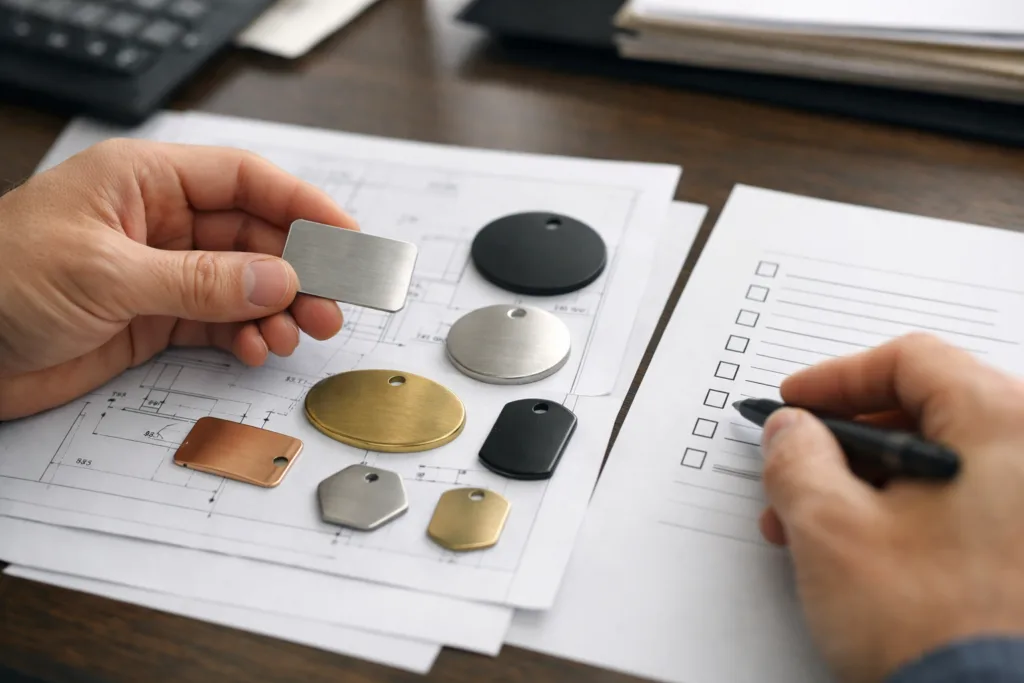
Material selection impacts both the cost and performance of metal tags. The three most common materials—aluminum, stainless steel, and brass—each offer specific traits and pricing dynamics.
| Material | Price Range | Durability | Corrosion Resistance | Application Suitability |
|---|---|---|---|---|
| Aluminum | $$ (Low-Med) | High | Good (anodized) | General industrial, outdoor, asset tags |
| Stainless Steel | $$$ (High) | Very High | Excellent | Harsh environments, marine, petrochemical |
| Brass | $$$ (Med-High) | High | Good (not marine) | Luxury branding, certain ID or compliance applications |
Aluminum is a cost-effective choice that balances light weight and corrosion resistance. When anodized, it withstands outdoor environments and aggressive use. Stainless steel is more expensive but excels in extreme or corrosive conditions (like marine or chemical handling). Brass tags bring a classic look and resist tarnish, making them popular for luxury and branding, though in severe environments they may underperform compared to steel.
Bulk purchasing can accentuate the cost differences between materials. Price breaks on aluminum may appear at lower thresholds due to simpler processing, while custom-finished brass or stainless steel tags may require higher minimums to trigger substantial bulk discounts. For more specific application advice, consider the details in Brass vs. Steel Tags: Which Lasts Longer Over 5 Years?.
Manufacturing Methods and Their Cost Implications
The method chosen for tag production can swing both costs and price breaks—sometimes dramatically. Common approaches include engraving, stamping, chemical etching, and UV printing. Each has its own material compatibility, setup needs, and impact on unit price as volume increases.
- Engraving: Suited for moderate-sized batches, particularly where deep, highly readable text is required. Often associated with modest bulk discounts due to machine time and tool wear.
- Stamping: Favors large runs, as tooling investment is amortized over thousands of pieces. Deeper bulk discounts are possible starting at higher MOQs.
- Chemical etching: Enables fine detail and works for small to medium-to-large orders. Discount thresholds may start at 500–1,000 pieces, higher for complex designs.
- UV Printing: Good for colorful, multicolor tags. Offers flexibility at lower volumes but may not reach the deepest discounts seen with stamping or etching.
For example, a 1,000-run of custom-engraved stainless steel tags will almost always cost more per unit than 10,000 deep-stamped aluminum tags—both in terms of material waste and machine cycle times.
Customization—such as variable data, QR codes, or unique shapes—usually raises minimum order thresholds for significant price breaks. To understand the trade-offs in depth, check How Size, Colors & Material Choices Drive the Real Cost of Metal Tags.
Design & Spec Checklist for Metal Tags
Proper preparation prevents costly mistakes when ordering metal tags in bulk. Here’s a concise checklist for design and specification communication with any manufacturer:
| Specification | Considerations |
|---|---|
| Size & Shape | Confirm overall dimensions and custom outlines; tolerance to +/- 0.2mm is typical |
| Thickness | Match application: 0.5–2.0mm for most tags; thinner for keychains, thicker for industrial tags |
| Finish | Matte, glossy, anodized, plated, brushed—affects legibility, corrosion resistance, aesthetics |
| Readability | Font size, text contrast, QR/barcode clarity (see Expert Guide: Designing QR Codes That Scan Every Time on Metal Tags) |
| Attachment | Pre-drilled holes, adhesive, slots, S-hooks or ball chains according to environment/application |
| Environment | Outdoor, chemical, or marine requires special finishes or materials |
| Itemized Specs | Send a clear sheet listing all details to minimize errors or miscommunication |
This checklist not only speeds up quoting, but also triggers discussions with the supplier about practical trade-offs, alternate materials, or manufacturing tweaks to optimize unit cost and durability in bulk orders.
Durability Testing and Performance Standards
Durability is non-negotiable for most industrial and commercial buyers of metal tags. Testing ensures products will meet regulatory and application needs in harsh environments or over multi-year lifespans. Common performance tests include salt spray (for corrosion resistance), UV exposure (to simulate sunlight/humidity), and abrasion (for machine-wear scenarios).
Outdoor performance is frequently specified—especially for asset management, utility, transport, and construction tags. A typical expected lifespan might be 3–10 years for anodized aluminum, and 10–20+ years for premium-grade stainless steel in aggressive industrial settings.
Industry standards such as ASTM or ISO may also apply to metal tags, especially in regulated industries. Buyers should check if certifications or compliance labels are required for their application, and communicate these needs clearly when requesting quotes.
In practice, choose sample tags for lab or field testing before committing to a full bulk order. For more on pre-production sampling, see Should You Pay for a Pre-Production Sample?
Durable tags shine in environments exposed to salt, heavy wear, chemicals, or frequent cleaning cycles—typical for marine, factory, utility, and fleet management uses.
Industry/Application Fit for Bulk Purchasing
Bulk metal tags find value in a wide array of industries where identification, traceability, and branding matter. Here are several common use cases:
- Asset Tracking: Manufacturing plants, construction, and logistics operations use serialized or QR-coded tags for permanent equipment tracking.
- Branding & OEM Plates: Electronics, automotive, and appliance producers affix custom logo/nameplates for a lasting brand impression.
- Compliance & Regulatory Tagging: Safety, instructional, and compliance plates (e.g., UL labels, marine tags) are deployed in batch form and require certified durability.
- Retail & Luggage: Branded bag, keychain, and luggage tags are often purchased in the tens of thousands for global campaigns.
- Garment & Accessories: Fashion brands use custom metal garment tags to reinforce exclusivity and support item traceability.
- Facilities & Signage: Hospitals, schools, and government agencies deploy readable, serial-numbered metal tags for wayfinding and asset management.
Customization is extensive in nearly every sector, ranging from size and finish choices to serial number application per tag or even unique customer branding. In volume, bulk purchasing offers long-term cost control, supply certainty, and consistency across project cycles.
Common Mistakes to Avoid in Bulk Purchases
Ordering metal tags in bulk brings efficiency—but also magnifies missteps. Common pitfalls include:
- Poor readability: Overly small fonts or low-contrast finishes can render text or codes unreadable. Always request proof samples for approval; refer to Expert Font Size Guide for best practices.
- Wrong adhesive or attachment: Failing to match the attachment to the usage environment (e.g., using light adhesive in industrial settings) causes field failures. Consult with your supplier if unsure.
- No pre-production sample: Skipping samples risks unexpected color, finish, or tolerances. Invest up front in test pieces to avoid floor-wide corrections later.
- Unconfirmed specs/tolerances: Misalignments in size or finishing specs can cause batches to fail quality checks or not fit the intended usage.
- Ignoring post-order troubleshooting: Delayed reporting of defects or miscommunications can make it impossible to resolve production issues. Verify shipment contents promptly.
For more guidance on avoiding design errors, read 5 Costly Design Mistakes That Stall Your Custom Tag Order.
Ordering Guide for Bulk Metal Tags
Efficient procurement starts with understanding the steps and expectations throughout the ordering process. Here’s a concise overview:
- MOQ (Minimum Order Quantities): Confirm required MOQs for standard vs. custom tags. Standard is often 100–500 pieces; for complex customization, expect 1,000 or higher.
- Lead Times: Standard tags typically ship in 2–4 weeks, but custom finishes or complex forms may require 4–8 weeks depending on batch size.
- Artwork & Proofing: Always submit vector art for clean detail; review and approve production proofs prior to run.
- Sampling: Ask for pre-production or standard samples—this ensures expectations are met and enables hands-on quality checks. [See standard samples and custom metal tag samples]
- Packing & Shipping: Discuss labeling Sop, packaging requirements, and logistics (especially for international or regulated shipments). For more, see Mastering International Metal Shipping.
If you’re working through your first order, or have questions about customizations or bulk discount triggers, get in touch with the UC Tag technical team. We can walk you through the typical specs and timing trade-offs from the shop floor up.
Frequently Asked Questions

At what quantity do bulk discounts typically start for metal tags?
Bulk discounts often begin at around 500–1,000 pieces for standard tags, but more complex or custom tags may require higher quantities to trigger significant price reductions.
Can I negotiate for better pricing if I plan repeat orders over a year?
Yes, suppliers often offer improved bulk discounts or lower MOQs for buyers who commit to blanket orders or signal repeat purchasing over time, especially with clear communication.
Which material is cheapest for durable metal tags in large batches?
Aluminum is generally the most cost-effective for large runs, especially when anodized for durability, while stainless steel and brass usually have higher base costs and discount thresholds.
What details should I confirm before placing a bulk metal tag order?
Verify specifications like size, finish, thickness, attachment method, required tolerances, and provide approved artwork or a sample, to minimize miscommunication and errors.
Does off-season purchasing really help lower costs on bulk tag orders?
Yes, buying during off-peak periods when supplier capacity is higher can increase the likelihood of deeper bulk discounts and shorter lead times for custom orders.
Is a pre-production sample always necessary before mass production?
While not mandatory, pre-production samples are strongly recommended to confirm specs, finish, and readability, reducing the risk of costly errors on bulk orders.
Summary and Call to Action
Understanding pipeline pricing, quantity thresholds, and the factors influencing bulk discounts enables informed, strategic sourcing for metal tags. By aligning order quantities with industry discounts, customizing specs for application fit, and timing purchases smartly, buyers can realize significant savings and avoid classic pitfalls.
Preparation is essential—communicate needs, confirm all specifications, and always request samples. Material and method choices should be practical, not just aspirational: consider durability, environment, and performance standards. A transparent approach from both the engineering and procurement sides ensures consistent, high-quality outcomes. Don’t hesitate to reach out for RFQs, advice, or best practices around custom manufacturing solutions for your next bulk metal tag order—thoughtful planning makes all the difference.
Related Reading
- Unlock Cost Savings with Smart MOQ Planning for Metal Tag Orders
- How Pre-Production Samples Reduce Costly Bulk Tag Mistakes
- Master the True Cost Drivers of Metal Tags: Size, Color & Materials Revealed
- Avoid Expensive Design Errors on Custom Metal Tag Bulk Orders
- Learn How Expedited Schedules Impact Tag Pricing and Lead Times
- See Real Durability Results: Brass vs. Steel Metal Tags After 5 Years