Introduction to Mold Fees
Mold fees are a crucial—and often confusing—part of custom manufacturing for metal tags and other products. Whenever an item needs a unique shape, imprint, or high-volume production, a specialized mold is created. The cost of making this mold is typically billed to the client as a one-time or split fee, separate from unit pricing.
This initial investment covers material selection, machining, and precise finishing. Depending on complexity and tolerance, mold fees can range from a few hundred to several thousand dollars. While it can be tempting to focus only on per-unit costs, ignoring mold fees may lead to surprise expenses mid-project or obstacles scaling from prototype to production.
Who owns the mold after it’s made? That question sparks more complexity—mold ownership can impact future orders, design control, and even part reordering with other manufacturers. Getting clear on these costs isn’t just good procurement practice; it’s an informed step that helps minimize delays, streamlines engineering schedules, and reduces friction with suppliers.
Understanding mold fees gives your team leverage to negotiate, plan budgets accurately, and prevent bottlenecks in your custom metal tag production lifecycle. In this guide, we’ll clarify the true meaning of mold fees and explore mold ownership so you can move forward with confidence.
Defining Mold Ownership

The question of mold ownership directly affects your rights and future flexibility in manufacturing projects. Typically, after payment of the mold fee—whether in full or through a split arrangement—the client may expect to own the mold. However, ownership status is rarely a simple hand-off. Each manufacturer has its own written or implied policy.
Ownership often depends on contractual terms outlined in the purchase order or supply contract. In some scenarios, the manufacturer retains full control of the mold, merely promising exclusive use for the client’s projects. In others, molds are considered client assets and can be shipped or reused elsewhere if the relationship ends.
Legal agreements are essential. A standard mold ownership clause covers where the mold is stored, responsibilities for maintenance or replacement, and disposal rights. The mold fee itself doesn’t always equal outright ownership; be sure to confirm before committing. Negotiation is possible, particularly in high-volume or long-term agreements.
Several factors influence mold ownership status. These include the method of payment (upfront or amortized into the per-unit cost), the presence or absence of a purchase agreement, and whether any intellectual property is involved in the design.
Engineers and procurement professionals should clarify client expectations from the outset. If the goal is full mold ownership, always specify this in the contract. Otherwise, be prepared for arrangements where the manufacturer keeps the mold for internal use, as is common in industries focused on efficiency and IP protection. Real-world practice, as UC Tag’s Rain Chen explains, balances liability and workflow speed, so openly discuss priorities for reorders or project transitions.
The Relationship Between Mold Quality and Production Costs
The quality of a mold sets the tone for production costs and finished goods performance. There’s a strong correlation between durability, output consistency, and the initial mold fee paid. High-quality molds often mean higher upfront costs, but they also result in fewer issues during mass production.
Well-made molds deliver tight tolerances, reduce product defects, and eliminate excessive rework or scrap. This stability minimizes line stoppages and lost materials—factors that quickly add up if using a lower-grade mold. In short: investing in mold quality helps avoid the false economy of saving on mold fees but paying more for operational headaches.
The material used for molds has a significant impact. For example, aluminum molds are more affordable and suitable for short runs, while stainless steel molds handle demanding, high-volume jobs because of their wear and corrosion resistance. Brass offers a middle ground: it’s tough and precise but costs less than stainless steel. Your choice of material directly affects both the initial mold fee and the longevity of your tooling.
Industries such as automotive, electronics, and heavy industrial labeling are especially sensitive to mold quality because small defects can result in major reputational or compliance risks. When custom metal tags are produced for outdoor, marine, or transportation environments, the consistency provided by a premium mold is invaluable.
- Investing in mold quality reduces hidden costs down the line.
- High-performance molds support large production runs without frequent touch-ups.
- Skimping on mold fees may result in rejected batches or safety-critical failures.
Consider the real price of reliability before choosing a lower-tier mold or accepting the lowest possible fee.
Comparing Manufacturing Methods
Metal tags can be produced via engraving, stamping, chemical etching, or UV printing—each method impacting mold fees, complexity, and suitability for the end application. Knowing the differences helps you match the right process to your project requirements.
Engraving (laser or CNC): Engraving offers excellent resolution and flexibility, often without complex mold needs. It’s perfect for variable data or small batch runs but has slower throughput and slightly higher per-unit costs.
Stamping: Stamping requires dense, robust molds (dies) capable of withstanding heavy, repeated force. The initial mold fee is higher, but the process is fast and cost-effective for large production runs, such as serial number plates or branded logo tags.
Chemical Etching: Etching uses masks and chemicals rather than hard tooling. The mold fee is moderate and design changes carry less risk, making it popular for fine, complex details on thinner tags or quick-turn projects.
UV Printing: This digital process often skips the traditional mold entirely, relying on software-driven image transfers. This can eliminate mold fees altogether, but has durability limitations outdoors unless paired with protective coatings.
| Method | Mold Complexity | Mold Fee | Best For | Drawbacks |
|---|---|---|---|---|
| Engraving | Low | Low-Moderate | Small batches, variable data | Slower for mass production |
| Stamping | High | High | High-volume, durable parts | Costly for frequent design changes |
| Chemical Etching | Moderate | Moderate | Fine details, medium runs | Chemical handling required |
| UV Printing | Very Low | None-Low | Colorful, complex images | Lower scratch resistance |
The ideal method considers not only initial mold fees but also repeatability, update frequency, and production speed. For metal tags requiring sharp, repeatable text for safety or asset tracking, stamping or etching with robust molds is often essential. If your project is heavily design-driven—like promotional luggage tags or event badges—engraving or printing methods let you avoid certain mold fees while maintaining flexibility.
To understand more about which process to choose, see our die stamping vs. die casting guide for practical advice.
Materials Comparison for Durable Molds
Material selection is pivotal for achieving both durable molds and clear mold ownership. The most common choices—aluminum, stainless steel, and brass—present clear trade-offs for performance, price, and environment.
Aluminum molds are lightweight, easy to machine, and ideal for short- to medium-length runs. They’re less costly, but they wear out faster under high-volume or abrasive stamping operations.
Stainless steel molds command a higher upfront cost, but they excel in long-term durability, corrosion resistance, and maintaining dimensional accuracy. These are favored in harsh manufacturing environments, outdoor exposure scenarios, and by clients planning years of repeat orders.
Brass strikes a balance: moderate cost, good machinability, and reasonable wear resistance. It works well for decorative or lower-stress applications but may not perform as long in intensive industrial settings.

| Material | Durability | Cost | Resistance (Corrosion, Wear) | Suitable Environments |
|---|---|---|---|---|
| Aluminum | Medium | Low | Moderate | Short runs, dry and indoor |
| Stainless Steel | High | High | Excellent | Outdoor, marine, industrial |
| Brass | Moderate | Moderate | Good | Decor, medium-run labels |
Environmental factors—humidity, chemical exposure, temperature swings—should directly influence your material decision. If your project involves tags for marine equipment, consider stainless steel molds and parts proven through salt spray tests. For less abrasive office or retail environments, aluminum may suffice with a lower mold fee.
Always ask for durability certification. If you plan to claim mold ownership and expect transfers to other facilities, ensure you receive full documentation describing material composition and performance. This allows your team to confidently use or relocate the mold without guesswork.
Design and Specification Checklist
Building an effective mold starts with clear specifications. Overlooking details early means higher mold fees later, so use this checklist to guide your initial design:
- Size: Specify all dimensions, including depth or relief height.
- Thickness: Match to both product use and material limits.
- Finish: Choose from matte, high polish, or specialty coatings (for better readability or corrosion resistance).
- Attachment: Indicate locations for holes, notches, or adhesive zones.
- Tolerances: List critical tolerances to minimize variation in the final tags.
- Readability: Confirm text size and font for clear legibility under actual use conditions.
- Mass Production: Ask if your design can be made efficiently within unit-per-hour targets.
Design choices have a direct effect on mold fees. Complex cutouts, fine text, or multi-level reliefs all drive up tooling costs. On the other hand, efficient designs with standard part sizes, optimized fonts, and simplified attachment points help keep mold fees manageable.
When in doubt, provide clear vector artwork. Not only does this simplify the mold making, but it also ensures your tags will be readable and consistent. For more, see our guidance on why vector art files are non-negotiable in metal molding.
Durability and Testing of Molds
Nothing reveals hidden faults faster than stress testing. Thorough durability tests validate if a mold—and its output—can survive its intended lifecycle, which is critical for understanding both mold ownership and associated costs over time.
Common testing methods include corrosion resistance (salt spray or chemical exposure), abrasion (simulating repeated handling or environmental hazards), UV resistance (for outdoor use), and even thermal cycling for environments with drastic temperature changes. These tests are especially important for industries like utilities, petrochemical, and outdoor equipment labeling.
Outdoor exposure places special demands on both the mold’s material and design accuracy. A poor-quality mold may pass initial production but struggle with repeat cycles, especially after repeated exposure to harsh elements. Each failure adds downtime and unexpected costs—not just for molds, but also for replacements and product recalls.
Testing protocols differ by industry. For example, marine tag applications may require salt spray testing, while industrial asset tags need abrasion tests to confirm long-term legibility. When negotiating mold ownership, insist that certification data or sample inspection reports be included in your handover documents—this supports a clean, documented transfer of responsibility.
Case studies show that customers who insist on rigorous mold testing experience fewer disruptions and lower lifetime costs. At UC Tag, Rain Chen frequently advises clients to budget for initial and periodic testing, as it’s the best way to protect both the investment in their mold and their overall manufacturing ecosystem.
Common Mistakes and Troubleshooting
Mistakes in the mold process are more common than most expect—even experienced buyers run into issues with unreadable text, wrong adhesives, or unexpected corrosion just weeks into service. These failures are typically preventable with the right precautions up front and regular oversight.
Unreadable text often stems from designs that don’t meet minimum size requirements or include overly decorative fonts. Always request a proof or physical sample to check legibility. For adhesive issues, select adhesives that match your tag’s environment—outdoor, indoor, rough, or smooth surfaces all require different solutions.
Corrosion and peeling point to unfit material selection or lackluster finishing. Poor contrast can result from choosing surface finishes that obscure text, such as polished metals without fill or UV ink lacking proper underlayers. These problems increase not just rework but also mold fees if adjustments require a new tool or additional finishing steps.
Troubleshooting existing molds starts with a root cause analysis—material review, exposure testing, and checking for wear or misalignment. Don’t overlook routine maintenance or adjustments if you notice lowers yields. Pre-production samples, even if they increase mold fees marginally, are a powerful insurance policy: they allow you to catch flaws before committing to full scale-up.
For a deep dive into design mistakes and prevention, see 5 design mistakes that stall orders and how to avoid them.
Ordering Guide for Mold Manufacturing
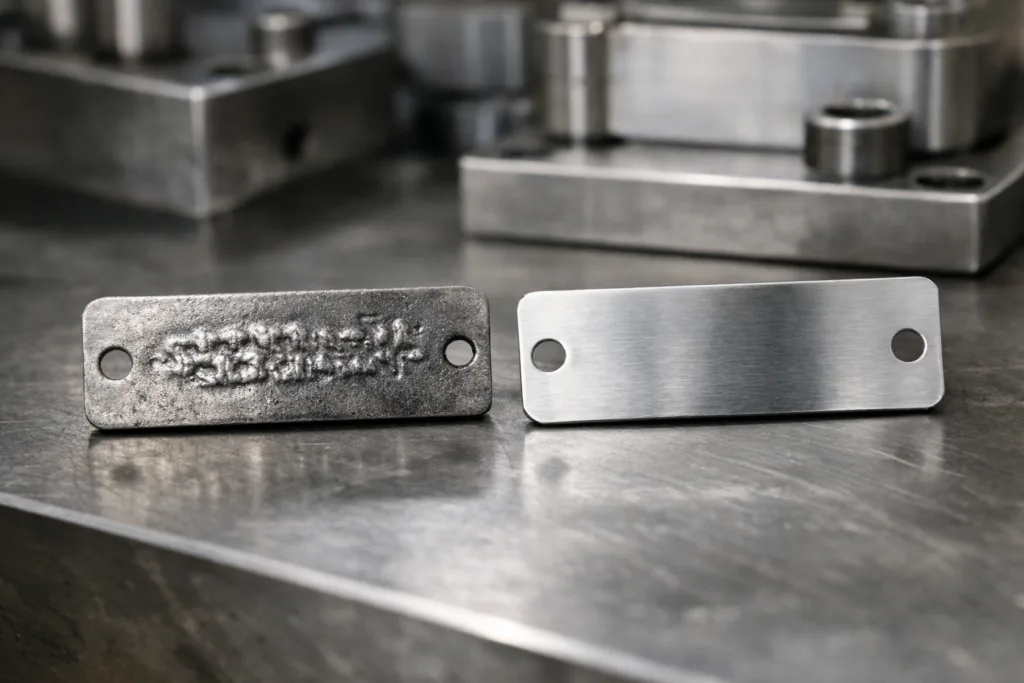
Navigating the mold manufacturing order process may seem daunting, but a clear checklist reduces errors and delays. Understanding mold ownership at every step helps you maintain control over both budget and future production flexibility.
Minimum order quantities (MOQ) and lead times are often set by your manufacturer based on process and mold complexity. Custom molds for stamped tags could require higher MOQs (e.g., 500–1,000 pieces) with lead times from two to four weeks, while engraved or printed tags can sometimes be produced faster and at lower quantities.
Artwork and proofing are critical. Always submit accurate files (preferably vector format) and review proofs before proceeding. Many manufacturers, including UC Tag, provide digital or physical samples so you can confirm details before mass production—the small investment up front can save substantial time and expense later.
When ordering, specify packaging and shipping needs clearly, especially for fragile or serialized tags. If you plan to claim mold ownership, clarify storage, retrieval, and shipping fees for transferring molds between facilities.
Clear, structured communication with your manufacturing partner streamlines the process, reduces rework, and keeps expectations aligned for both sides.
Frequently Asked Questions
What factors influence mold fees?
Mold fees are driven by mold complexity, size, design detail, choice of material, finish requirements, and the selected manufacturing process; complex or high-durability molds cost more up front.
Can mold ownership be transferred?
Yes, mold ownership can be negotiated and transferred through contractual agreement, usually upon full payment of the mold fee and with provisions covering storage, maintenance, and shipping.
What happens if the mold breaks during production?
If a mold breaks, contracts should specify who pays for repair or replacement; in many cases, the owner assumes responsibility, but some manufacturers offer coverage within a warranty period.
How do changes to my design affect mold fees and ownership?
Design changes may require a new mold or mold modification, incurring additional mold fees; ownership rights should be clarified for each version to avoid conflicts or delays.
Does durability testing affect mold fees or ownership?
Durability testing can increase initial mold fees due to quality assurance and certification costs, but it is vital for validating performance and transferability of ownership, especially in regulated fields.
Can I reuse my mold with a different manufacturer?
You can reuse your mold elsewhere only if you possess full mold ownership and have transferable documentation; not all manufacturers accept used molds due to fit, IP, or technical reasons.