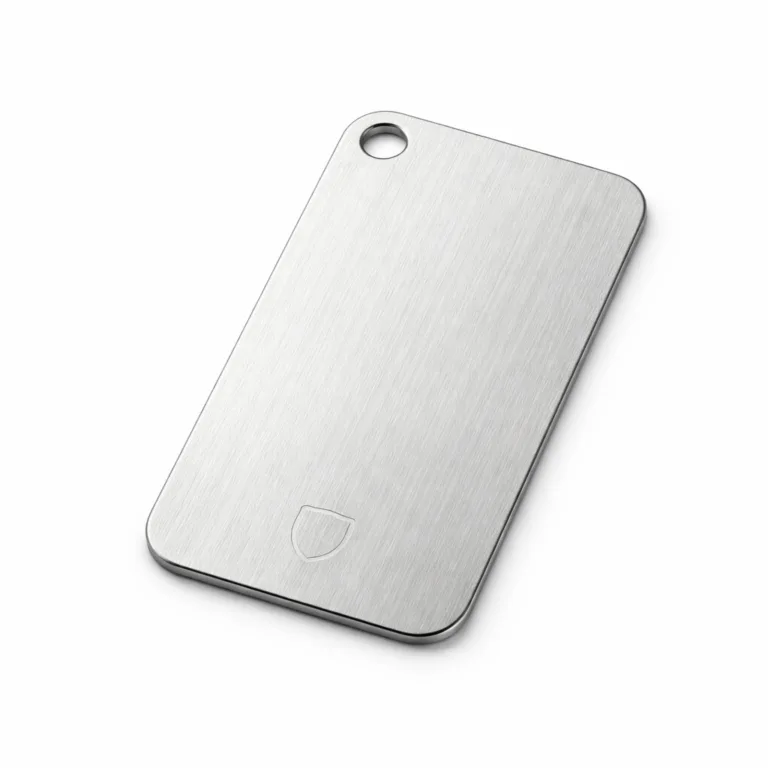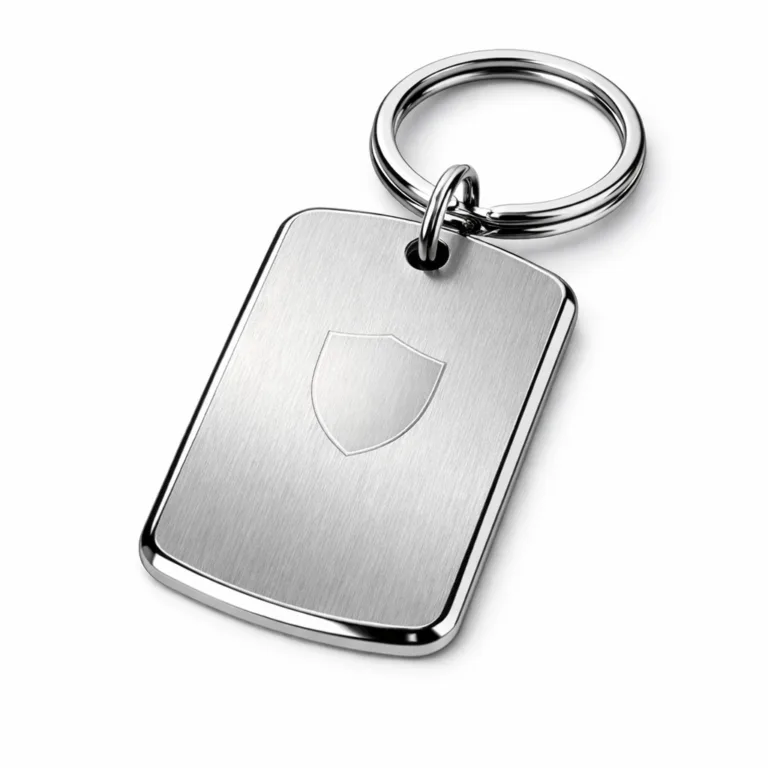
Metal pricing tags are a practical upgrade for shelf displays when retail teams need cleaner presentation, better durability, and fewer pricing problems on the sales floor. Compared with paper inserts, temporary stickers, or low-cost plastic labels, metal tags hold their shape, keep a more consistent appearance, and support a more permanent merchandising system. For buyers managing store fixtures, branded displays, or multi-location rollouts, the real question is not only whether metal looks better. It is whether the tag structure, marking method, attachment style, and update process fit daily retail operations.
If your project needs reliable shelf labeling with repeatable dimensions, durable finishes, and controlled branding, our custom metal tag manufacturing solutions are built around the details that usually decide whether a display works well in stores or creates extra maintenance later. We help retail and fixture buyers review material options, marking methods, SKU or price field layouts, attachment styles, sample approval points, and bulk production consistency so the tags match the real shelf system instead of becoming an afterthought after fixtures are already installed.
What metal pricing tags are and where they are used in shelf displays
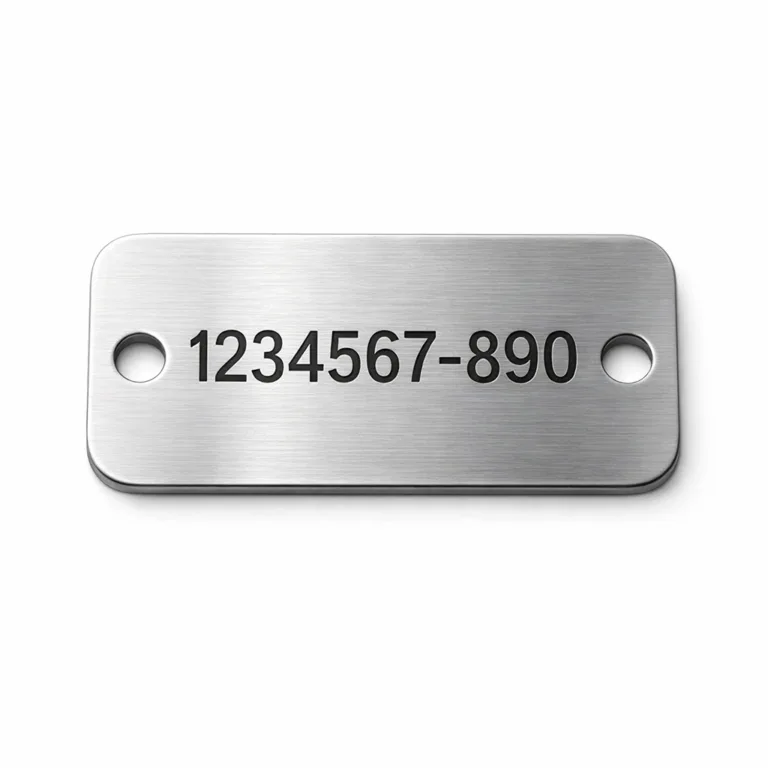
In shelf merchandising, metal pricing tags are small custom plates or labels used to show price, product name, SKU, promotional information, barcode data, or brand elements on shelf edges, display trays, freestanding units, cabinets, and product islands. They are common in specialty retail, electronics stores, hardware shops, supermarkets, showroom displays, museums, boutique merchandising, and branded fixture programs where the display itself is part of the product experience.
Some tags are simple blank-backed price holders with one engraved or printed value. Others are designed as permanent branded plates with variable fields for item number, product family, or promotional changeouts. In many projects, the best result comes from separating what should stay fixed from what should change. For example, a tag may use a durable metal base with logo and product family permanently marked, while price information is updated through a replaceable insert, sticker, or protected printed field. That decision affects cost, speed of updates, and store-level accuracy.
From our manufacturing perspective, the first step is defining whether the tag is meant to be permanent, semi-permanent, or frequently updated. Buyers sometimes ask for a very durable metal tag but also want daily price changes. That is possible, but the design must match the update cycle. Otherwise, a premium tag can become inconvenient for store teams.
Why retailers choose metal pricing tags over paper, plastic, or temporary signage

Retail teams usually move to metal pricing tags for three reasons: appearance, durability, and control. Metal looks more stable and intentional than a printed card in a plastic strip. It also resists curling, tearing, edge wear, and discoloration better than paper-based options. In higher-value product categories such as watches, jewelry, eyewear, electronics, knives, tools, and premium packaged goods, that difference is easy for shoppers to notice.
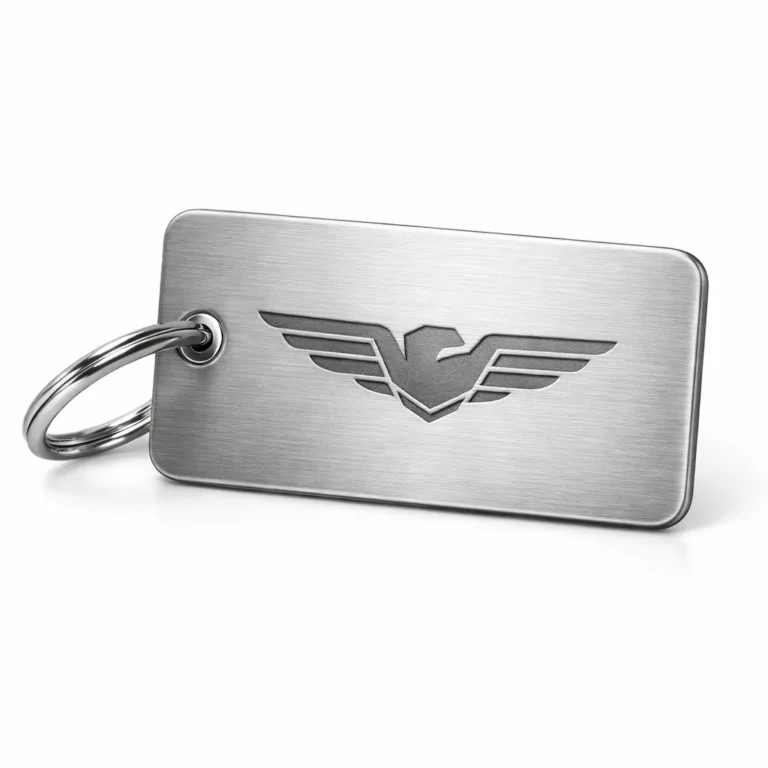
There is also a practical side. Temporary labels are easy to replace, but they often create uneven shelf presentation. Corners lift. Ink fades. Adhesive residues build up. Different stores improvise different formats. Over time, the display stops looking standardized. Buyers who need stronger visual consistency often ask us for logo tag production support for retail branding so the same tag structure, finish, and brand placement can be repeated across fixture programs.
Plastic has its place, especially for low-cost high-turn labeling, but it can scratch easily, look less premium, or discolor under lighting and cleaning exposure. Metal tags are not automatically the right answer for every aisle, but they are often the better answer where brand perception, fixture quality, and long-term presentation matter.
How metal tags improve shelf appearance, brand consistency, and perceived product quality
Shelf displays do more than show a price. They frame the product. A well-made metal tag helps create order on the shelf and supports a more deliberate presentation. Straight edges, consistent color, controlled hole positions, and crisp marking all contribute to a cleaner fixture face. This is especially important on custom displays where product packaging, lighting, and hardware are already carefully selected.
For buyers, the key is not just the product name or price, but whether the tag proportions match the display geometry. A tag that is too tall may crowd the product. A tag that is too small may look lost on a wide shelf rail. If the finish is too reflective, overhead store lighting can reduce readability. If the corner radius does not match the fixture language, the display can look mismatched even when the tag itself is well made.
We often recommend treating metal pricing tags as part of the fixture specification, not as a last-minute accessory. That means confirming visible area, color family, edge treatment, logo placement, attachment point spacing, and whether the shelf front is flat, curved, powder-coated, wood-faced, glass-mounted, or inserted into a holder. For programs that need a more plate-like look, buyers sometimes review precision metal nameplates for display labeling because the same manufacturing logic used in branded nameplates can also improve shelf-facing retail tags.
Pricing accuracy and readability matter more than many buyers expect
On a busy sales floor, a price tag only works if shoppers and store staff can read it quickly. Clean typography, enough contrast, and the right amount of information matter more than decorative styling. A common mistake is trying to put too much content on a small metal plate: product name, price, SKU, barcode, promo note, size, finish, and logo all at once. The result is a crowded tag that slows reading and increases shelf errors.
Good shelf-facing tags usually prioritize information in a clear hierarchy. Price should be the fastest element to identify. Product name or short descriptor comes next. SKU, barcode, or internal store data can be secondary if used more by staff than by shoppers. Contrast is also critical. Dark text on a light matte background, or light text on a dark controlled background, is usually more dependable than low-contrast metallic-on-metallic styling. The International Sign Association provides useful sign contrast and readability guidelines for shelf price tags that align well with practical retail viewing conditions.
Clear shelf communication also supports navigation and product finding. In retail environments, shoppers often scan horizontally and make quick comparisons between adjacent items. Research on interior wayfinding helps explain how signage supports shopper navigation and product finding, which is relevant when shelf tags are expected to reduce confusion in dense merchandising areas.
This detail may look small, but it can create problems later if it is not confirmed early. If one store can read the shelf tag easily and another cannot because lighting, glare, or font scaling changed, the issue is usually specification, not installation.
Best materials for retail pricing tags
For most shelf displays, the main material options are aluminum, anodized aluminum, stainless steel, and brass. Each has a different balance of look, durability, and cost.
| Material | Best Use | Advantages | Considerations |
|---|---|---|---|
| Aluminum | General retail shelf tags | Lightweight, economical, easy to fabricate | Surface protection and finish choice matter for scratch resistance |
| Anodized aluminum | Branded retail systems, engraved fields | Good color control, clean appearance, durable marked layer | Color matching and finish consistency should be reviewed in samples |
| Stainless steel | High-wear or cleaning-heavy environments | Strong, corrosion resistant, premium look | Higher cost, more reflective if finish is too polished |
| Brass | Boutique or heritage-style displays | Warm premium appearance, decorative value | Weight, finish maintenance, and branding fit should be considered |
In many indoor retail projects, anodized aluminum gives a strong cost-performance balance. It is light, visually clean, and works well for engraved or laser-marked information. Stainless steel becomes more attractive when tags are touched often, exposed to aggressive cleaning, or used in damp spaces such as garden, food-adjacent, or semi-outdoor merchandising. Buyers comparing finishes and stock options often start with material choices for engraved retail tags before locking the final artwork, because appearance and marking method are closely linked.
Choosing the right marking method for price fields and branded graphics
The best marking method depends on how permanent the information is and what the shelf environment will do to the surface.
Engraving
Engraving is a good choice for permanent item numbers, fixed product names, and branded plates that need a sharp, tactile result. It works especially well when durability matters more than photographic detail.
Etching
Etching is useful for fine-detail graphics, precise linework, and clean text on stainless steel or brass. It can produce a refined look for premium retail displays.
Laser marking
Laser marking is efficient for serialized information, variable data, barcodes, and controlled repeatability. It is often selected when multiple SKUs share one tag format.
Stamping
Stamping can be practical for certain deep, durable impressions, but it is less common for shelf tags that need a polished branded look and exact visual consistency across varied layouts.
Printed graphics
Screen printing or UV printing is useful for color logos, promotional elements, and higher-visibility shelf communication. The tradeoff is that printed surfaces should be evaluated carefully for abrasion, solvent exposure, and cleaning routines.
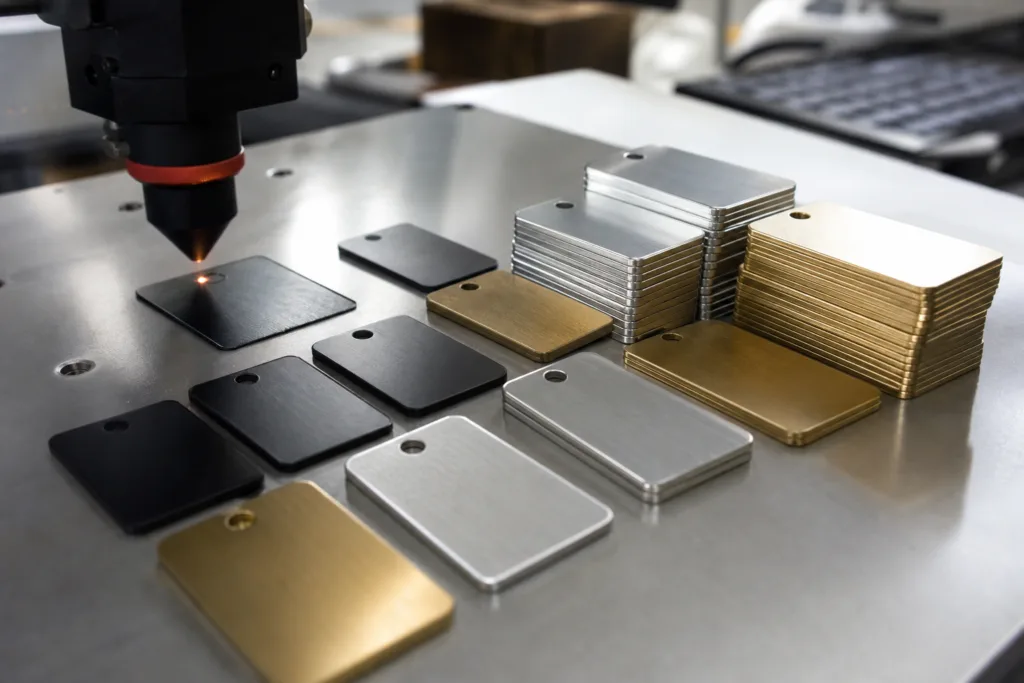
In our custom metal tag production work, the common issue is not choosing the wrong process category. The problem is mixing permanent and changeable information without deciding which part really needs long-term durability. That is where a hybrid approach often works better than a one-process solution.
Design considerations for metal pricing tags in shelf displays
Good retail tag design usually looks simple, but it depends on many small decisions working together. Let’s look at what actually affects the result.
- Size: Confirm not only overall tag size, but also visible reading area after clips, holders, bends, or rails cover the edges.
- Shape: Square corners look technical and modern; rounded corners feel softer and can reduce snagging during cleaning.
- Font: Choose a typeface that remains readable at shelf distance. Narrow fonts may fit more text but often reduce scan speed.
- Contrast: A matte background and high text contrast usually outperform glossy decorative finishes under store lighting.
- Color: Use color intentionally. A branded accent can help category recognition, but too many colors reduce consistency.
- Logo placement: Keep logos present but secondary. A shelf tag is still an information tool first.
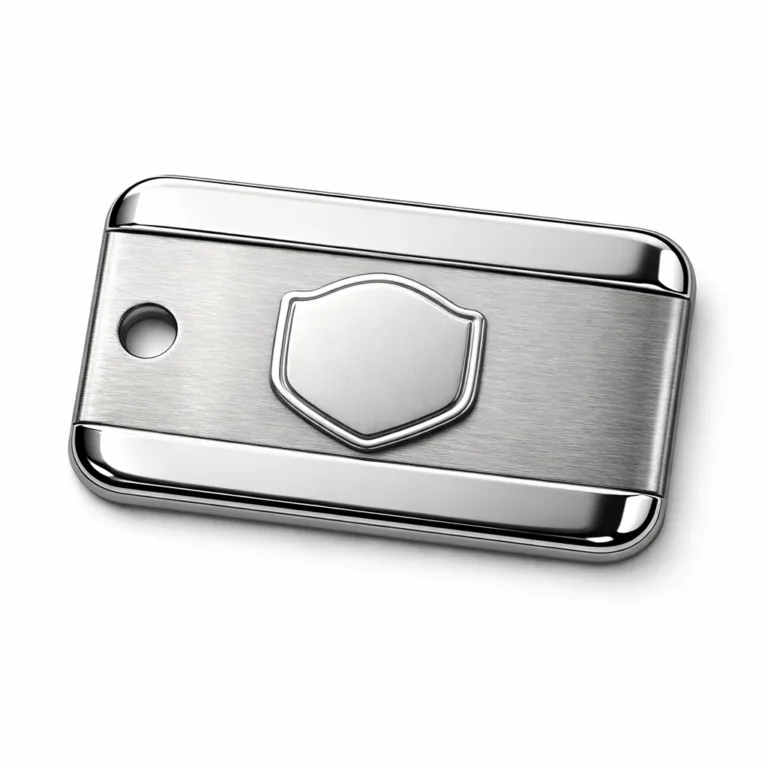
If your display is brand-led and needs a controlled badge-like appearance, working with UC Tag early in fixture planning helps align dimensions, artwork limits, finish selection, and production tolerances before the shelf hardware is frozen.
Customization options that support retail operations
Customization is where metal pricing tags become either very effective or unnecessarily complicated. The useful options usually include product name, price field, SKU, size or variant code, barcode, QR code, promo message, logo, finish color, and mounting style. The question is which combination helps the store team work faster without overloading the tag.
SKU and barcode fields are especially helpful when retail teams need matching between planograms, replenishment systems, and on-shelf presentation. If you plan to scan from the shelf, confirm barcode size, contrast, quiet zone, and scanner distance before approving production. QR codes can work for product stories, digital menus, or stock information, but they should not replace clear visible pricing when quick shopping decisions are the goal.
For chain rollouts, data accuracy is just as important as tag quality. Buyers should confirm whether the factory will receive one artwork file with a data spreadsheet, multiple SKUs with shared layout, or completely different artworks by store or category. Serial or variable data projects need a clean import process and a sample proof that checks both layout and content logic. This is one area where production planning saves more time than rework ever will.
Attachment and mounting methods for shelf integration
The right tag fails if the mounting method is wrong. Shelf displays vary a lot: flat metal shelf fronts, powder-coated frames, wood shelves, acrylic trays, wire racks, glass cabinets, slotted rails, and magnetic displays all require different attachment logic.
| Attachment Method | Best For | Benefits | Watch Points |
|---|---|---|---|
| Adhesive backing | Clean flat surfaces | Fast installation, low visual clutter | Surface energy, cleaning chemicals, and removal expectations |
| Clips or holders | Frequent price updates | Easy changeout | Holder tolerance and visible edge coverage |
| Holes and screws | Permanent display fixtures | Secure and repeatable | Hole location must match shelf hardware exactly |
| Magnets | Metal shelving and modular displays | Repositionable | Magnet strength and theft/tamper considerations |
| Slide-in channels | Integrated fixture systems | Neat appearance | Thickness tolerance is critical |
For store fixture buyers, the key is confirming how the tag is installed, removed, cleaned around, and updated by staff wearing gloves or working quickly during resets. A very strong adhesive may sound safe, but it can become a problem if seasonal displays need clean removal. On the other hand, a removable holder may create movement or misalignment if the shelf is bumped often.
Durability in real retail environments
Retail is not as harsh as heavy industry, but tags still face repeated wiping, hand contact, shopping cart impact, shelf restocking, carton abrasion, moisture from refrigerated or entry-adjacent areas, and UV exposure near windows. That is why finish selection matters even for indoor use.
We usually ask buyers about cleaning chemicals, expected touch frequency, and whether the display is fixed for years or refreshed by season. A tag used in cosmetics or electronics may face daily wiping and frequent customer interaction. A tag on a hardware rack may face abrasion from packaged tools. A garden-center shelf may see humidity and occasional water exposure. Those are different jobs, and one default metal plate does not cover all of them.
Corrosion is not always the first concern for indoor merchandising, but it becomes relevant in damp areas, coastal locations, refrigerated zones, or semi-outdoor displays. Buyers planning longer-life programs should review rust resistance guidance for long-lasting tags so the chosen material and finish fit the real store environment instead of only the showroom sample.
Operational benefits for store teams and fixture programs
Well-specified metal pricing tags can reduce replacement frequency, improve shelf consistency, and simplify audits. Store teams benefit when tags stay aligned, remain legible, and use a predictable layout across categories. That reduces the small but frequent errors that happen when stores improvise paper labels or mixed-format holders.
At the sourcing level, standardizing tag families can also make rollouts easier. Instead of buying one-off signage for each fixture, buyers can create a controlled tag system by category, size, and mounting style. For example, a program may use one size for regular shelves, one for endcaps, and one for premium cabinets, all with the same visual language. That makes reordering easier and reduces confusion during future fixture expansion.
Specification checklist for ordering custom metal pricing tags in bulk
Before requesting a quote or sample, we recommend confirming these points:
- Application: permanent shelf label, semi-permanent branded plate, or frequent-change pricing tag
- Material: aluminum, anodized aluminum, stainless steel, or brass
- Thickness and size tolerance
- Corner style and edge finish
- Visible artwork area after installation
- Marking method for fixed data and variable data
- Text hierarchy: price, product name, SKU, barcode, QR code, promo text
- Logo location and color requirements
- Attachment method and exact mounting dimensions
- Cleaning and wear exposure
- Quantity by SKU and total order volume
- Packaging by set, by store, by category, or bulk carton
- Sample approval process and acceptable tolerances
This detail work is what prevents delays later. In many projects, the problem is not manufacturing capability. It is that artwork, mounting dimensions, and update logic were approved separately instead of as one system.
Common mistakes to avoid before sampling and installation
- Choosing a premium metal without checking glare under actual store lighting
- Overloading a small shelf tag with too much text
- Using an attachment style that conflicts with cleaning or seasonal resets
- Approving color from a screen instead of from a physical sample
- Forgetting to confirm barcode readability after final finish is applied
- Ignoring packaging logic for multi-store rollout and shelf-set installation
- Treating the tag as separate from the fixture dimensions
Sampling should test more than appearance. It should also test fit, reading distance, install speed, removal method, and whether the chosen process keeps the data clear after handling. A good sample helps answer operational questions before bulk production, not after it.
Conclusion
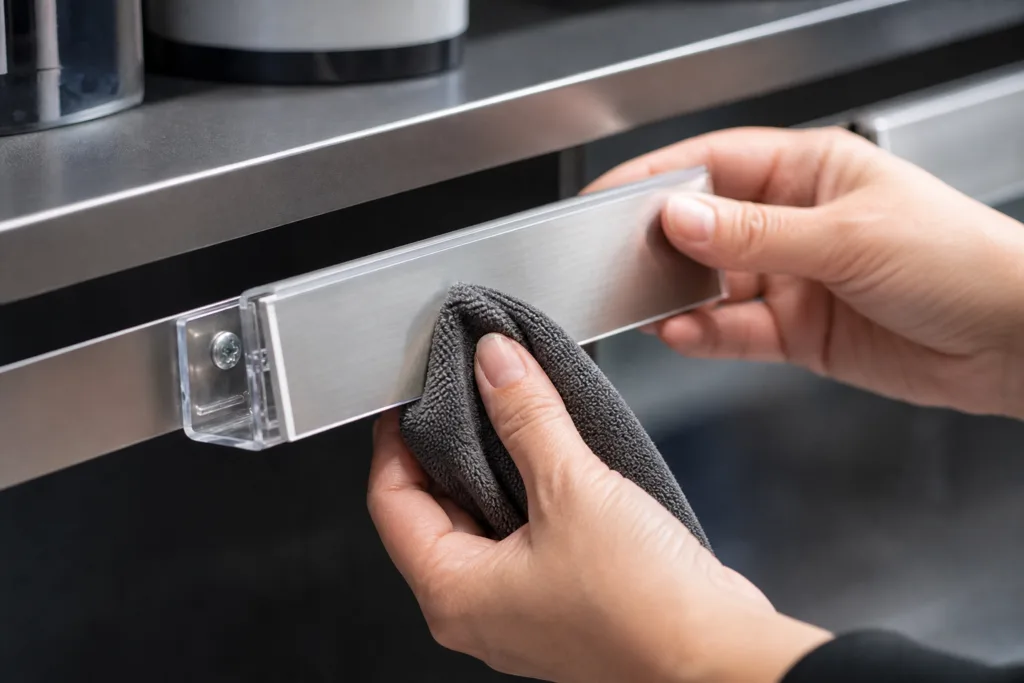
Point of sale metal pricing tags can be a strong choice for shelf displays when buyers need a more durable, professional, and controlled merchandising system. The main decision is not simply whether to use metal. It is how to match material, finish, marking method, data layout, and mounting style to the real retail environment. When those details are confirmed early, metal pricing tags support cleaner shelves, better consistency, easier maintenance, and fewer pricing problems over time.
FAQs
Which material is usually best for metal pricing tags on retail shelves?
For many indoor retail programs, anodized aluminum offers a practical balance of appearance, weight, cost, and marking performance. Stainless steel is useful when tags face heavier wear, more aggressive cleaning, or damp conditions. Brass is usually selected for premium or decorative displays where visual style matters as much as function.
Can metal pricing tags include barcodes or QR codes?
Yes, metal pricing tags can include barcodes or QR codes, but the layout has to be planned carefully. The code size, contrast, quiet zone, and final surface finish all affect scan performance. For shelf scanning projects, it is smart to test a physical sample with the actual scanner and viewing distance before approving bulk production.
What marking method is best if prices change often?
If prices change often, a fully permanent engraved price is usually not the most efficient choice. A better approach is often a hybrid design with permanent metal branding or product information plus a replaceable insert, printed field, or holder-based update area. This keeps the display looking consistent while making store updates easier.
How should buyers choose between adhesive, screws, clips, or magnets?
The choice depends on the shelf material, how often the tag must be removed, and how clean the fixture face needs to look. Adhesive works well on flat surfaces with low change frequency. Screws are better for fixed installations. Clips or holders help with repeated updates. Magnets are useful on metal fixtures when repositioning is important.
What should be approved before placing a bulk order?
Before bulk production, buyers should approve the exact size, thickness, finish, artwork layout, text hierarchy, mounting dimensions, variable data format, packaging method, and a physical sample whenever possible. It is also important to confirm how many SKUs are involved and whether each one uses the same template or different artwork.
Are metal pricing tags worth it for standard shelf displays?
They are worth it when the display is expected to stay in use for a long period, when brand presentation matters, or when paper and plastic tags create too much maintenance. For short campaigns or daily price changes, a lower-cost temporary system may still be more practical. The right decision depends on update frequency, fixture quality, and the level of visual consistency the retailer expects.